
The world of Learning and Development (L&D) has never been so dynamic and challenging. In an environment where rapid changes and digital transformations set the pace, leaders and professionals in the field are rethinking how to create learning programs that truly impact organizational performance.
Today, we dive into the 10 key training and development trends that shape how teams work and learn to achieve peak performance in 2025 and beyond.
To do this, we analyzed the global landscape, gathered insights from people development professionals, and explored emerging trends that promise to redefine the future of corporate learning.
Key Trends to Follow:
- Increasing Technological and Data-Driven L&D
- Human-Centric vs. Office-Centric Approaches
- Cultural Gaps Are a Thing of the Past
- Artificial Intelligence: From Hype to Intentionality
- Soft Skills as “Power Skills”
- The Rise of Skills-Based Work
- Optimistic Budget Projections
- Leadership Development Takes Priority
- Continuous Learning and Autonomy
- Purposeful Work: The Key to Engagement
1. Increasing Technological and Data-Driven L&D
The accelerated progress of technology is profoundly transforming training and guiding trends in learning and development.
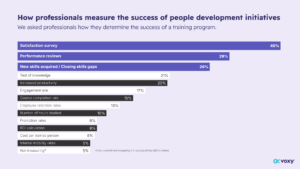
New tools and platforms now provide greater visibility into key L&D metrics, enabling professionals to move beyond “vanity metrics” such as study hours and satisfaction rates, and focus on more robust business metrics such as Return on Investment (ROI) and team productivity increases.
However, recent research from Voxy reveals that this is still not the reality for most companies.
Additionally, AI-powered tools, microlearning, and gamification not only capture employees’ attention and help combat shorter attention spans, but also deliver tangible business results.
Scalability and accessibility of learning programs are becoming top priorities. Online training platforms are enabling companies to offer personalized, accessible, and flexible learning experiences.
This presents a unique opportunity for people development professionals to expand their development plans to include not only a deeper understanding of people, work, and new technologies, but also enhanced skills in data and analytics.
There will also be increasing pressure to optimize and justify technology investments with a stronger strategic and data-driven L&D plan. While “vanity metrics” show whether people are engaged and enjoying the training, they provide little insight into how the strategy connects to the critical skills needed for the organization to achieve its business goals and outperform competitors.
2. Human-Centric vs. Office-Centric Focus
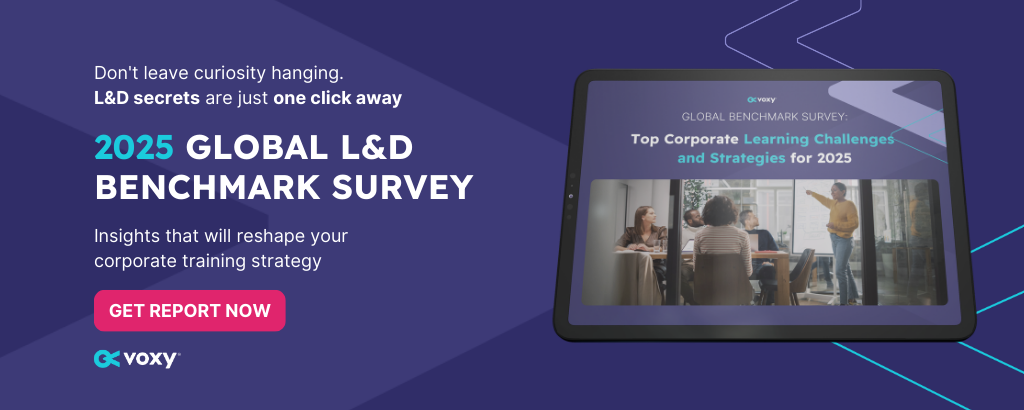
In recent years, the corporate world has undergone a major transformation, especially regarding work modalities. According to the recent Gartner study on the future of work, the concept of a human-centric workplace is gaining traction, replacing the traditional office-centric view and shaping trends in training and development.
This new model focuses on addressing human needs rather than forcing people to adapt to outdated practices or rigid workplaces, emphasizing three key points:
Flexible Work: Giving employees the option to choose where and when to work helps them achieve a better work-life balance.
Intentional Collaboration: Combining teamwork for specific tasks while respecting individual preferences allows everyone to contribute their best work. Depending on the task, this may involve a careful blend of in-person and virtual collaboration.
Empathy-Based Management: Employees want to feel valued in their journeys and trust their organization. For this reason, it is crucial for management to show care and support through their actions.
In a flexible work environment, the learning culture must be adapted. In a world where employees enjoy greater autonomy, companies must ask themselves: how can individual development be aligned with business objectives? A strong organizational culture that encourages continuous learning and fosters team collaboration is the key to success.
For L&D professionals this means delivering training programs that are not only scalable, but also providing meaningful learning opportunities asynchronously while maintaining live interaction and collaboration among team members.
3. Cultural Gaps Are a Thing of the Past
With the rise of remote and hybrid work, organizations continue to face the challenge of building strong, cohesive cultures capable of engaging globally distributed teams.
According to Gartner, 57% of Human Resources (HR) leaders report that managers fail to reinforce the desired cultural vision within their teams, and less than 23% of employees understand how organizational values connect to their daily routines.
This disconnect can directly impact engagement, performance, and even talent retention.
To overcome this challenge, the report recommends that organizations integrate culture into everyday behaviors and processes, transforming values into tangible practices. Companies that successfully achieve this report a 63% increase in engagement, a 35% boost in performance, and a 25% rise in employee retention intentions.

Providing specific training in intercultural skills, especially for global and hybrid teams, also plays a crucial role in fostering shared values, diversity, and inclusion, improving collaboration, and strengthening the sense of belonging—essential for talent retention.
Now more than ever, L&D leaders have the opportunity to transform organizational culture into a competitive advantage by connecting people, strategies, and technologies in an increasingly dynamic global market.
4. Artificial Intelligence (AI): From Hype to Intentionality
With the massive boom in AI, many companies are attempting to adopt this technology on a broad scale. However, it’s crucial for L&D professionals to approach AI with a pragmatic mindset. It’s not enough to adopt it for its popularity; there is a growing need to use it purposefully. Gartner’s studies reveal that while 49% of Chief Executive Officers (CEOs) plan to invest in AI in the next three years, 61% believe companies are advancing faster than employees can adapt.
Much of this may be tied to employees’ ongoing fear that AI could threaten their jobs, which underscores the need for training programs to address both the technical skills and the emotional aspects of this transition. Additionally, transparency about how AI will be utilized can help increase acceptance and alleviate fears surrounding technology.
The key to success in this case is intentionality: using AI to solve specific problems and improve team processes and productivity, rather than adopting it simply because it’s trendy.
L&D professionals must therefore invest in personalized training programs that align AI and other technology learning with clear business objectives. They should also focus on AI-driven tools that help customize and streamline learning journeys. Change management is crucial to ensure employees understand the value of technology and feel included in the innovation process. AI should not be an end in itself, but a means to drive efficiency and engagement within the organization.
5. Soft Skills as “Power Skills”
In a world where hard skills can be quickly replaced by technology, soft skills—rebranded as “power skills“—are emerging as an essential competitive differentiator. A Deloitte study estimates that by 2030, two-thirds of job positions will heavily rely on these skills, reinforcing their central role in training and development trends. As a result, the demand for interpersonal skills has never been more urgent.
Voxy’s Global Benchmark Survey (featuring insights from over 350 industry professionals) revealed that L&D professionals are increasingly aware of the importance of fostering interpersonal skills within teams. They recognize that critical thinking, empathy, and effective communication are essential for maximizing the benefits of AI in organizations, helping teams collaborate more efficiently, solve complex problems, and strike a balance between automation and human interaction.

6. The Rise of Skills-Based Work
The shift towards a skills-based approach is gaining momentum, and its impact is already evident in large organizations adopting practices that prioritize skills over academic qualifications or fixed job titles. This reflects the need for more agile skills development aligned with the demands of a rapidly evolving market.
Studies from Deloitte indicate that 90% of executives are implementing skills-based practices, transforming how they hire, train, and develop their teams.
This means L&D leaders need to invest in tools that map critical skills and create programs aligned with market demands. This includes leveraging platforms that analyze skill gaps and provide personalized learning paths to address these needs.
7. Optimistic Budget Projections
In our annual survey conducted with people development professionals from large companies worldwide, we asked about their expectations regarding training and development investments for the coming year, and the results are undeniably optimistic.
The survey revealed that 48% of L&D professionals expect an increase in their budgets for 2025, a significant jump compared to 33% last year. This budget growth presents a golden opportunity for training and development professionals to think strategically about how to allocate these resources to maximize impact and prepare teams for future challenges.
From what we’ve observed so far, it’s clear that the focus shouldn’t solely be on technical training, but also on enhancing interpersonal skills such as communication, conflict resolution, and collaboration. This approach will help companies build a workforce that is not only competent but also adaptable and resilient.
8. Leadership Development Takes Priority
Leadership development has been identified as the greatest challenge for 2025. According to Voxy’s survey, investing in effective leaders will be crucial for organizational success.
Despite significant global investments—approximately $60 billion annually in leadership programs—the concrete results remain limited: only 10% of programs deliver measurable impacts. This highlights a structural problem in traditional leadership training methods, which often lack the personalization and relevance needed to meet the demands of today’s market.

A critical aspect of this scenario is the need to adapt leadership programs to the organizational context. This means aligning training with the company’s strategic goals while considering emerging trends, new technologies, and rapid changes in the business environment. Moreover, leadership training programs that incorporate analytical skills enable leaders to prioritize high-impact tasks, fostering a manageable and efficient workload.
To address this, organizations must adopt tailored methodologies that combine practical learning, mentoring, and flexibility. Successful leadership programs require a holistic approach, integrating continuous learning with hands-on experiences. The use of digital tools to monitor leaders’ progress is also essential.
9. Continuous Learning and Autonomy
Autonomy in learning is essential for employee engagement. Mandated or prescribed learning often fails to generate the necessary commitment for employees to truly engage in the development process. Self-directed learning, where employees have the power to choose their learning paths and apply them in the flow of work (Learning in the Flow of Work – LIFOW), is becoming a dominant training and development trend.
This approach allows employees to tailor their learning journeys to their needs, focusing on skills that directly impact their roles. Models such as microlearning and on-demand learning platforms are powerful tools that offer accessible and personalized content. These formats give employees the flexibility to integrate learning into their routines, learning at their own pace while aligning with the demands of a constantly evolving market.
However, autonomy in learning does not mean a lack of support. To ensure engagement, L&D teams must create supportive environments where technological tools, continuous feedback, and a culture that values development are priorities. These practices help employees apply what they learn to their daily work, connecting their learning journeys to tangible results.
10. Purposeful Work: The Key to Engagement
The concept of employee engagement has been a well-established priority for companies, but in 2025, the focus on meaningful work promises to redefine this landscape. More than simply ensuring satisfaction or task completion, true engagement arises when employees connect emotionally to organizational goals and find purpose in what they do.
Recent studies show that employees who consider their work meaningful feel 37% more fulfilled, even in high-pressure environments or with demanding workloads. This data reveals that the impact of purposeful work goes beyond individual well-being, directly influencing productivity and team resilience. For companies, prioritizing meaningful work is not just a retention strategy, but an essential driver for long-term organizational performance.
In this context, L&D professionals play a crucial role. It is necessary to go beyond developing technical and interpersonal skills and create programs that reinforce the alignment between employees’ personal goals and the company’s strategic objectives. When employees see a growth path that combines their individual progress with organizational success, they feel more valued and motivated, driving engagement naturally and sustainably.
Conclusion
What we’ve explored and discussed today makes it clear that the future of training and development will be shaped by greater integrated strategies. Organizations aiming to thrive in 2025 will need innovative approaches that balance technological advancements with human needs, foster continuous learning, and prioritize the development of essential skills for individual and organizational success.
The global work landscape demands more than technical competencies; it requires empathy, adaptive leadership, and genuine engagement. By adopting practices like self-directed learning, the development of soft skills—or power skills—and program personalization, companies can create even more resilient teams aligned with their strategic goals.
L&D professionals play a vital role in this journey, leading the cultural and operational transformation of organizations. With increased budgets and new tools available, this is the time to think strategically and invest in initiatives that drive measurable and sustainable impact.
More than ever, corporate learning is not just a resource but a motivator of transformation and growth. By embedding these trends into their company’s DNA, leaders and teams will be ready to face the challenges of a constantly evolving market and achieve a future of high performance and innovation.
Voxy offers job-specific language training designed to unlock your team’s potential. Our AI-powered solution and microlearning approach improve team communication for better results. Schedule an assessment today.