
The vision you may have to transform your organization’s learning and development efforts probably includes investing in new tools and developing efficient initiatives. But, unless your L&D budget gets the senior leadership’s approval and support, taking your company to the next level is merely an idea.
Leadership buy-in is more than just an approved budget. Senior leadership needs to understand, believe in the vision and be an advocate for the training and development plan. And it’s up to you to up your influence game and convince them.
Promoting L&D to Leadership
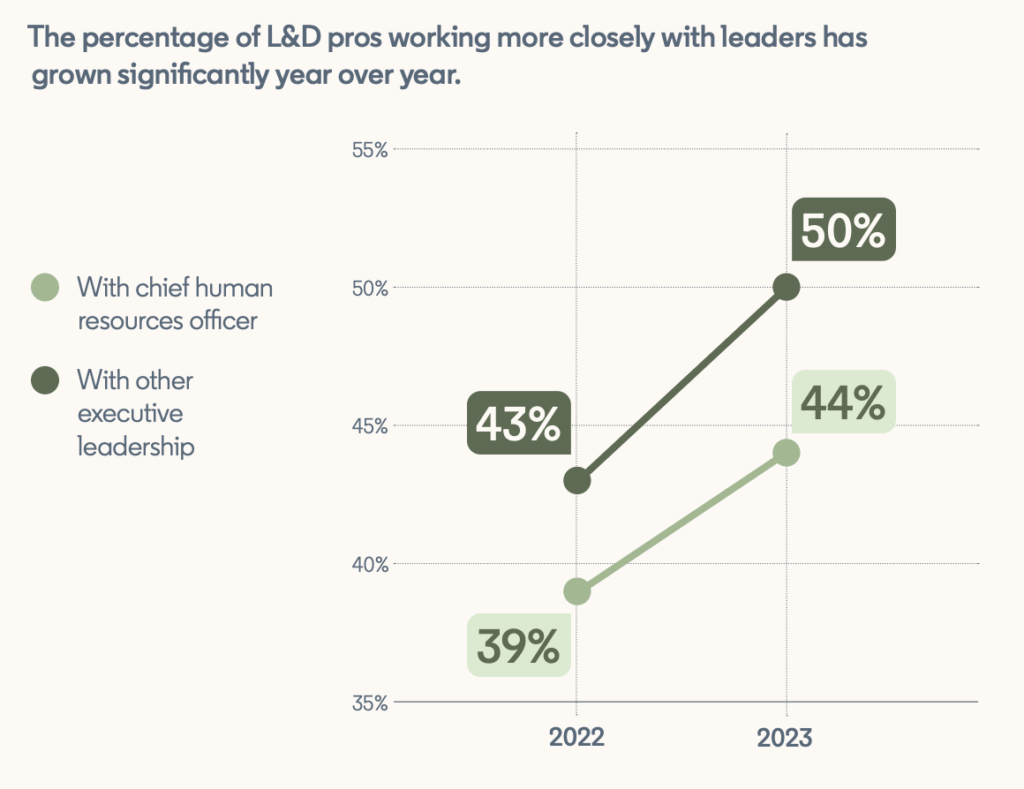
According to the Linkedin Learning Report, L&D pros are strengthening the relationship and working more closely with leaders year over year.
Organizations are realizing that their employees are their most valuable asset and 93% of leaders are concerned about employee retention, and acknowledging the significance of investing in their development is as crucial to achieving business success.
Organizations establishing an L&D budget commonly set the budget based on employees’ total salaries. Many experts suggest the training budget should be somewhere between 2% and 5% of the company’s entire salary budget.
Another approach to building an L&D budget is program-based company-wide initiatives rather than cost-per-employee, or a mix of the two approaches.
Let’s make sure that leadership sees the larger vision beyond the training and development budget and gets excited to see it come to reality.
Tips for Gaining Leadership Buy-in for the L&D Budget
According to projections, the global training market is expected to expand by approximately 1.4% in 2024. It means that leaders around the world are seeing the benefits of corporate, but you still need senior leadership to be on board 100%.
Here are some tips to get your budget approved:
#1 Plan in alignment with business goals
In an ideal scenario, every organization would have a clearly defined corporate education strategy. However, the reality paints a different picture.
This survey reveal that one in five organizations lack a well-defined corporate education strategy. Moreover, among those that do have a strategy in place, less than half affirm that it is properly aligned with their business objectives.

Corporate education stands as a pivotal means to cultivate and capitalize on the intellectual wealth of your team. It needs continual oversight to ensure synchronization with the evolving trends and demands of both the business landscape and the market at large.
Failure to achieve this alignment poses the risk of conducting training solely to fulfill immediate agendas or address leaders’ requests, without a proactive strategy.
This alignment starts with establishing strong relationships with team leaders, that way you are in sync with what every team’s specific needs to allow full performance.
#2 Estimate productivity gains
A strong L&D program is linked to improving employee performance and productivity. When done correctly, employee training provides the right skills and knowledge to help employees complete their jobs more efficiently and effectively.
Measuring productivity gains in training initiatives involves a combination of quantitative and qualitative methods.
- How much will training help improve performance?
- Will training help the workforce feel more confident about their ability to perform their job?
- Will it improve employee satisfaction and commitment?
- How will training improve teamwork, customer service, conflict resolution and other areas?
To get to numbers, during the training evaluation process you can ask participants to estimate how many hours per day, week, or month were gained as a result of the skills acquired in the training sessions.
#3 Have a plan to measure the ROI (Return on Investment)
Not measuring the return on investment (ROI) of training within corporate education can result in suboptimal resource allocation, ineffective decision-making, a lack of strategic direction, and missed avenues for growth and success.
According to a survey conducted by Voxy, which involved over 350 Human Resources professionals, a mere 11% of organizations actively measure the return on investment (ROI) of their training initiatives.
There are different ways to measure training ROI. If you have an estimation for productivity gains, you can estimate the ROI based in employees salaries.
One example of how ROI can be calculated for training programs:
A company invested in a time management and prioritization program for 100 employees. Productivity gains are measured either through surveys or performance evaluations.
Productivity increase: 8 hours per month, 96 hours per year
Cost per employee hour: $10
Profit: (96 x 10 x100)= $96,000
Investment: $20,000 USD
ROI=(96,000 – $20,000)/($20,000) = 380%
Showing training program’s ability to become self-sustainable over time is a very important part of getting your L&D budget approved, since understanding the real financial benefits is a top priority for CEOs.

#4 Show a scale-up strategy
Scalability is essential for L&D in large enterprises as it enables organizations to adapt to growth, cater to a global workforce, integrate new technologies, optimize costs, maintain consistency, and respond effectively to evolving business needs and employee expectations.

Here are some ways to make training programs scalable:
- Using digital learning platforms lets you provide training to many employees at once, no matter where they are
- Adopt platforms with an automated assessment feature to evaluate learner progress and provide feedback in real-time
- Plan for resources to supplement formal training that enable employees to access relevant information when needed, such as such as manuals, tutorials, and knowledge repositories
- Implement localization tools that use AI to automatically create multi language versions to adapt training materials for employees worldwide.
#5 Be prepared with relevant data and stats
To increase your chances of getting your training budget approved, collect data and statistics to back up what you are proposing.
Previous results, like improvements in key areas such as employee productivity, job performance, customer satisfaction, quality of work and data on employee engagement and satisfaction levels related to training programs.
Industry benchmarking, comparing your organization’s training metrics and performance against industry benchmarks and best practices, showcasing areas of competitive advantage or improvement opportunities.
Trends that can help leaders to understand that the initiatives are aligned with what is foreseen in the future for L&D.
Performance review summaries that help to identify overall training needs.
Succession plans to prepare potential successors by providing them with the necessary skills, knowledge, and experiences to excel in leadership roles.
#6 Set a meeting
Use a common strategy in sales, which is not to send the plan and budget without a meeting where you can advocate for the benefits before showcasing the investment. Face-to-face presentations reduce the risk of misunderstandings, allow for real-time feedback, and save time.
In the meeting, inspire confidence and garner support from stakeholders by illustrating the potential value and impact of the L&D plan and budget.
There is also a marketing technique that can be applied, that is to present a compelling vision of the positive outcomes and benefits that the proposed training initiatives will bring to the organization.
It involves highlighting how investing in learning and development will contribute to achieving strategic objectives, improving employee performance, enhancing organizational capabilities, and ultimately driving success and growth.
Final Words
Securing leadership buy-in for your Learning and Development plan and budget isn’t just about securing funding—it’s about painting a compelling vision of the positive outcomes and benefits your proposed training initiatives will bring to the organization.
Leadership support goes beyond financial approval; it’s about ensuring they understand, believe in, and advocate for the training and development plan.
By aligning your plan with business goals, estimating productivity gains, measuring ROI, showcasing scalability strategies, presenting relevant data and statistics, and setting face-to-face meetings to advocate for the benefits, you can inspire confidence and garner support from stakeholders. Remember, it’s about showcasing the value of L&D in driving organizational success and growth.
Voxy supports corporate customers in over 150 countries with access to live language coaching led by certified teachers and an extensive library of role-specific courses that fill crucial soft and technical skill gaps.
Click here to set a 15 minute assessment session to talk about your company’s language training needs.