
Some of the challenges organizations face when adopting a hybrid work model include poor communication, reduced collaboration, issues balancing personal and professional life, and disparities between in-person and remote workers.
A strong organizational culture is crucial for attracting and retaining high-level talent, fostering high performance, and achieving essential business goals.
In a survey conducted by PwC, 67% of respondents stated that culture is more important than strategy or operations for business success.
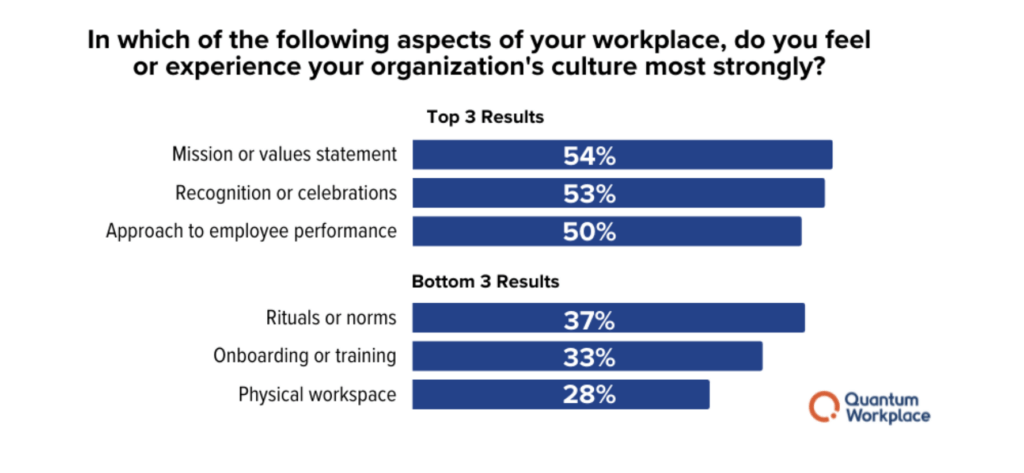
When assessing an organization’s culture, what do workers consider? According to a survey by Quantum Workplace, the company’s values and how it recognizes and evaluates its employees are the most significant influencers of a strong culture.

Interestingly, the physical workspace is the least influential factor in workers’ perception of culture.
For workers, hybrid and flexible work contributes to embracing a positive culture: this Gartner survey shows that a significant 76% of recently migrated remote and hybrid employees have a favorable view of the hybrid work environment.
Moreover, the results indicate that 64% of hybrid workers and 66% of remote workers state that their organization’s culture positively influences their job satisfaction, a significantly higher percentage compared to the 52% of employees exclusively working on-site.
Let’s delve into best practices to keep the company culture alive and thriving in hybrid teams:
Intentional and Relevant Communication
Communication barriers lead to misunderstandings, conflicts, information loss, and a decline in morale and connection among individuals.
Poor communication makes it harder to retain and engage top talent and reduces productivity, incurring substantial costs for companies.
Transparent communication channels foster a collaborative work environment and build trust within an organization. When leadership and employees openly share information and can communicate candidly, people naturally become more motivated and innovative.
Keeping everyone informed ensures that team leaders and members are aware of project progress and potential issues that arise.
Providing regular updates helps individuals focus on goals and tasks rather than investing energy in misunderstandings and mistrust.
Team members play a significant role in effective and concise communication in the workplace by expressing concerns, asking questions, and providing feedback, learning the necessary power skills to manage conflicts and achieve common goals.
Social Interaction
Research shows that quality workplace relationships are linked to increased productivity and well-being.
When a company encourages social interaction, it creates a social space where people can connect, communicate, and celebrate.
Opportunities for in-person interactions, even occasional ones, are positive but not always feasible in a hybrid or remote work model.
Some examples of social interactions for hybrid and remote teams:
- Virtual coffee breaks using apps like Donut (Slack integration), randomly pairing individuals in the organization for a quick connection and informal chat
- Virtual cards for birthday wishes and other occasions, like Kudoboard
- Online happy hours, which can be themed
- Interest-based workshops, such as a wellness session or something creative like a drawing workshop
These activities connect people beyond day-to-day work and foster a sense of belonging even when someone is working remotely.

Investment in Training and Development
People desire to grow and develop, learn new skills, and enhance their work performance – this LinkedIn survey shows that learning and growth opportunities are key drivers of a strong culture.
By investing in a training and development plan aligned with the company’s needs, employees feel better supported, enhancing productivity and work accuracy.
Other positive effects of talent development include improved worker morale and engagement, reduced turnover, and less need to recruit from outside the organization.
Even when individuals have autonomy to allocate their training budget, training professionals need an in-depth understanding of business objectives to map the competencies required for the company to reach the next level and ensure these skills are being developed.
Recognition of Contributions
Recognition programs enable workers to know that an organization values the work they do. By acknowledging and celebrating individuals who make relevant contributions, a company can boost morale, increase productivity, and reduce turnover.
Recognizing contributions can take various forms. Many organizations use performance-based programs that acknowledge employees who meet or exceed goals.
Celebrating work anniversaries and employee of the month or year programs are easy ways to recognize team members’ service. Peer recognition provides feedback while building relationships among team members.
Flexible Policies
Hybrid and remote work have become an irreversible trend, amplifying the need for training solutions adaptable to any time and place.
In a study titled “The Future of Work,” results revealed that 41% of companies plan to increase their remote workforce in the next two years, while 73% anticipate continuous growth in remote and flexible work settings.

The integration of flexibility and remote work has become an established reality for both employers and employees. In this Gartner survey, 60% of respondents expressed the expectation to work remotely at least once a week, a significant increase from the pre-pandemic figure of 38%.
Adopting flexibility yields substantial benefits: organizations meeting individual needs witness increased morale and empowerment through autonomy, leading to higher engagement and commitment to the company.
Gartner’s insights highlight a significant trend: companies embracing radical flexibility see an impressive 40% increase in employees identifying as high performers.
Technology Resources
Implement communication platforms that facilitate asynchronous interactions among remote and in-office teams. Tools like Slack, Microsoft Teams, or Zoom enable messaging, video conferencing, and real-time collaboration, promoting constant connectivity and information sharing.
Offer accessible and comprehensive training programs through corporate digital education platforms that are customizable to each individual’s profile and can be consumed anytime, anywhere, on any device, allowing learning to naturally fit into people’s daily lives – the increasingly strong trend of lifelong learning.
Feedback Mechanisms
In a healthy hybrid work culture, feedback is a two-way street between managers and team members. It’s up to an organization to develop and maintain a feedback culture that creates a safe environment for sharing and receiving feedback.
The goal of feedback is to collect, analyze, and respond to both positive and negative feedback with actionable solutions. Surveys, real-time systems, and bidirectional feedback systems are ways to keep track of a company’s work culture.
Feedback mechanisms show employees how important they are to a company, helping them improve performance and build trust. Quality employee experience management boosts morale and drives organizational culture.
Culture of Trust
In hybrid teams, where physical distance can create barriers, a culture of trust acts as the glue that keeps teams connected, engaged, and aligned toward shared goals. It’s not just important; it’s fundamental for success in such an environment.
Trust is directly linked to worker retention and engagement. People tend to stay longer in organizations where trust prevails, feeling more engaged and committed to the company’s objectives.
A culture of trust encourages innovation and knowledge sharing, creating a more resilient and cooperative workforce. By showing appreciation, a company can enhance employee satisfaction and performance and reduce turnover, which reduces training and integration costs and time.
Voxy supports corporate clients in over 150 countries, providing access to live instructor-led language training and an extensive library of specific courses that address critical gaps in technical and interpersonal skills.
Click here to schedule a 15-minute assessment session to discuss your company’s language training needs.