
Some voices in the market say that remote work can kill corporate culture. At the other extreme, there are cases of companies and people working 100% remotely (even before the pandemic), indicating that a strong organizational culture does not depend on being in an office every day.
Remote work environments are becoming more and more common and many people in leadership positions are thinking about how to build a company culture that makes sense for remote and hybrid teams.
In this article, we’ve put together tips for developing and promoting a solid organizational culture that can attract and retain the talent needed to reach the company’s business goals.
What is corporate culture and why is it important?
Culture represents the essence of the organization and speaks not about what the company does but about how the company does what it does, or how things get done.
It is in organizational culture that the values, beliefs, communication styles and principles that guide an organization’s actions are reflected.
Corporate culture is about:
- How a company positions itself, behaves and communicates
- How it hires people for the team
- How it celebrates its victories
- How it compensates its talents
- How it evaluates people’s performance
Culture impacts virtually every facet of a business and influences the conduct of all people involved. It also collaborates in attracting and retaining the right talent for the company’s values and objectives.
In this survey conducted by PWC with 3,200 professionals from companies around the world, 67% of respondents said that culture is more important than strategy and operations in achieving positive business results.
Having an organizational culture powerful enough to inspire action and results in the team not only attracts and retains the talent needed for good results, but also singles out those who don’t embody the company’s values.
Company culture has a strong link to team engagement – according to this survey, people who say their company culture is positive are 3.8 times more likely to have high engagement.
Organizational culture for hybrid and remote teams
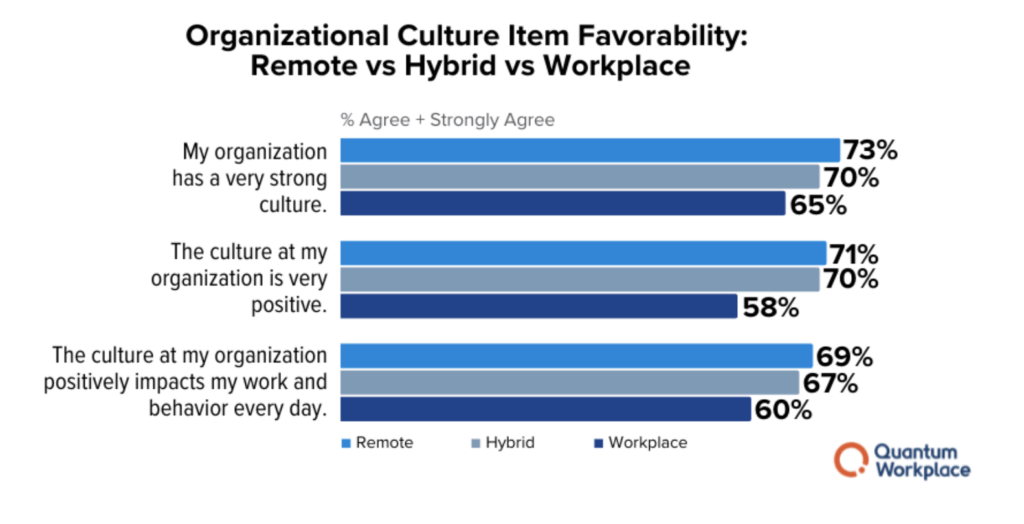
While some companies believe that corporate culture is damaged outside of a face-to-face environment, research like this shows a different perspective: people who work in remote or hybrid arrangements are more likely to view company culture in a positive light.
A growing number of surveys indicate that people prefer remote or hybrid work, such as this Gallup survey of 4,000 people in the U.S. labor market, which indicated that 56% of people say their jobs can be done from home, and 84% of people prefer hybrid or remote work arrangements.
This other survey shows even higher figures, with 97% of people interviewed saying that they want to work in a remote or hybrid working regime.
What are the main types of corporate culture?
There are several ways of describing a company’s culture. The most commonly cited is based on a model developed by researchers at the University of Michigan to understand criteria that can predict good company performance, and it highlights 4 predominant styles of company culture: collaboration, innovation, hierarchy, and competitiveness.

Collaborative culture: Doing things together
Collaborative organizational culture is centered on people and their natural tendency to work in teams to get things done.
Benefits related to wellness, room for honest feedback, mentoring programs, hiring that makes room for diversity, programs to learn languages and communicate with different cultures, and the creation of collaborative groups are some examples of actions centered on the human element.
Leadership style: facilitator, mentor, team builder
Main drivers: commitment, communication, development, lifelong and on-the-job learning
Rationale: happy and committed people produce positive results
Hierarchical culture: Doing things the right way
Hierarchical culture is related to characteristics such as structure, tradition, predictability, and stability. There is a clear and established order and layers between leadership and employees.
Likewise, the systems and processes in place are clear and firm, and have the same common goal: keep doing things that are working and replace those activities that do not provide good results.
Leadership style: coordinator, organizer, monitor
Main drivers: efficiency, consistency, uniformity, process
Rationale: control and efficiency with well-defined processes produce positive results
Innovative culture: Doing things first
Innovation culture values creativity and experimentation by encouraging the search for innovative solutions. As a result, it is expected to push boundaries by experimenting with new things and changing course when necessary.
Leadership style: futuristic, innovative, experimenter, creative, entrepreneurial
Key drivers: innovation, agility, testing, creation
Rationale: innovation, vision, and constant change produce positive results
Competitive culture: Doing things fast
Market culture, or competitive culture, prioritizes results when conducting business and decisions are usually looked at first from a financial perspective, with bold goals and many success metrics.
If on the one hand the companies with a culture focused on competitiveness are usually successful, the extreme demand can result in a team that is close to burnout and unmotivated, which can generate high turnover.
Leadership style: competitive-driven, results-oriented
Main drivers: market share, profitability
Rationale: Aggressive competitiveness and extreme customer focus produce positive results
How to determine the type of company culture
To identify or choose a type of organizational culture that fits the business objectives, one must be very clear about some important points.
- List the non-negotiable values that should be reflected in the organizational culture
- Compare with the types of corporate culture explained, identifying the most predominant in the way the company conducts or would like to conduct business
- List the pros and cons of each type
- Organize a round of feedback with the team
After the moment of reflection, it is time to list practical actions and initiatives that represent the type of culture that best suits the company and include them in each department’s plans.
7 tips for developing culture in remote and hybrid teams
We have gathered some initiatives that contribute to the development of a strong organizational culture with the ability to strengthen connection and collaborative work in remote or hybrid teams:
#1 Translate culture into tangible actions
Culture is a broad and subjective concept, so it is important that HR and leadership reflect the culture the company wants to build in a clear action plan with measurable goals.
Map out strategic decisions that are directly linked to culture, such as hiring initiatives for diversity and ESG, in the case of a collaborative people-focused culture, for example.
#2 Quality Onboarding
Start by impressing! Create and constantly refine an onboarding process that dedicates a new person’s first few weeks on the team to getting to know the company, the product, the market, understanding what their role will be, and getting to know the people they will interact with most frequently.
A person can be escalated in the organization to be an “onboarding buddy” for a new person on the team.

#3 Reflect the culture in the benefits package
Using the same example of a company that identifies with a people-focused organizational culture, when choosing benefits to attract the team, a company might include options such as days for mental health care and reimbursement for gym memberships.
#4 Provide opportunities to meet
Just because the team doesn’t meet all the time doesn’t mean they can’t meet eventually. The company can organize periodic events to bring some or all of the team together.
#5 Tools
Daily work-related communication tools such as Slack or Teams, the Donut application that works on Slack and schedules quick meetings between people for an informal conversation (the same that would happen over coffee at the office) and Kudoboard (cards signed by the whole team for special occasions) are some tools that bring people together and facilitate the development of the company’s culture.
#6 Team feedback
Include questions about company culture in satisfaction surveys and reflect the results of the evaluation in the planning. The company values remain, but the culture is fluid and changes according to the needs of the team and the market.
Periodically identify the gaps between the current culture and the culture that the company wants to have, with practical actions to reduce this gap, such as training in specific skills.
#7 Recognize those who are aligned to the company’s culture
With public recognition in periodic meetings and special awards, recognize the people on the team who stand out for incorporating the values reflected in the company’s culture and make the reason and the value that the person incorporates with mastery clear.
Conclusion
While a company’s values may change a little or not at all, corporate culture is not fixed and adapts to the needs of the team, society, the market, technology, and other influencing factors.
To gain the trust and respect of people with a strong and engaging culture is worth much more than an in-market salary and a good benefits package.
Companies with a strong organizational culture do not need to actively promote it – an engaging culture engages the team and is promoted by people organically. The role of the leaders in the company is to reflect the culture and values that the company wants to build in practical actions.
The tips in this article depend on effective communication, which can happen in people of different cultures in different languages.
Do you want to guarantee a fluent team with the skills to develop an organizational culture that leads to memorable results? Schedule a conversation with Voxy