
Did you know that, according to Deloitte, by 2030, professions that require interpersonal skills will grow 2.5 times faster than others, making up two-thirds of the job market? The question now is no longer how to adapt to the changes, but how organizations can prepare to thrive in this new scenario?
The speed of change in the job market is challenging companies to rethink their talent management strategies. The automation of routine tasks, globalization and cultural transformations require a new look at human capital. Today, technical skills are no longer enough; it is also necessary to invest in interpersonal skills and adaptability in order to thrive in a dynamic environment.
In this context, skills-based organizations are emerging as an innovative response. This model shifts the focus from diplomas and positions to the real potential and practical skills of each employee, creating more agile and effective teams. In other words, companies that adopt this approach will be better equipped to deal with the challenges of the future.
- What are skills-based organizations?
- Why are we seeing this trend grow?
- What are the benefits of this trend?
- Hard skills vs. Soft skills
- Where to start and how to implement this trend?
- Why are skills-based organizations crucial?
- From hiring to development: the ideal model
- Training and development trends for 2025
- The role of tools in skills development
What are skills-based organizations?
A skills-based organization measures an employee’s value based on their technical and interpersonal skills, rather than just their academic record or previous experience. It’s about prioritizing what an individual can effectively contribute to the company’s strategic objectives.
Such organizations define work based on the tasks and activities needed to achieve specific results and “break down” traditional positions into a set of skills, which describe the work to be performed in each role – with the ultimate goal of delivering pre-established results.
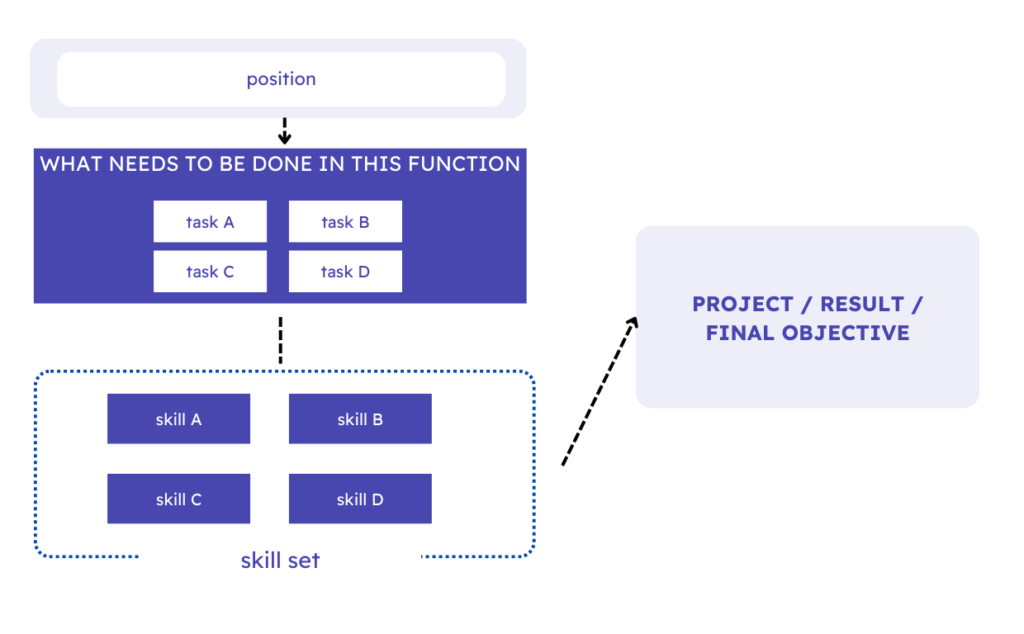
In this way, we can say that SBOs (Skills-Based Organizations) see employees as individuals with a unique set of skills, inside or outside the company’s fixed structure, and consider aspects such as hard and soft skills, potential, experience and seniority to distribute the work to be done.
The central idea of this movement is to forget the pre-defined boundaries of the job and embrace a workplace approach that prioritizes and organizes people according to skills. This perspective can be applied not only in the distribution of tasks, but also in hiring processes, leadership planning and other strategic decision-making moments.
Why are we seeing skills-based organizations grow?
This dynamic has gained momentum with the advance of automation, which has begun to replace technical and repetitive tasks, shifting demand towards skills that machines can’t replicate, such as emotional judgment and critical thinking. In addition, globalization has increased the complexity of the business environment, requiring skills such as multicultural communication and leadership in remote teams. But that’s not all: a survey by Deloitte shows other reasons for this change.
Employee well-being
The focus on human-centeredness at work is gaining prominence: 79% of business executives believe that the purpose of organizations should be to create value for workers as human beings and reported feeling increasing pressure to turn this ideal into concrete action. Adopting a skills-based work model also allows people to express their uniqueness and have tasks aligned with their strengths, rather than a standardized model.
Demand for more autonomy
Half of the workers interviewed said they feel highly attracted to companies where they have increased autonomy and can use their skills freely on a daily basis. While they want to reach their potential and be valued as unique individuals, only 26% feel that their employers really see them that way, recognizing their contributions and skills as something special.
Talent shortage
The shortage of talent will continue to be a challenge over the next three years, at least that’s what 63% of the leaders interviewed believe. To deal with this, they are looking for broader creative ways to find the skills they need, looking beyond traditional, professional or academic experience, thus opening up the range of possibilities in hiring.
The need for agility
In an era of rapid and unexpected change, 85% of business leaders agree that businesses need to find additional agile ways of structuring work and responding quickly to market transformations.
Digital transformation
According to 61% of the executives in the survey, evolving technologies that have emerged in recent times (such as automation and artificial intelligence) demand new skills and are also pushing their organizations to introduce a skills-based approach. Automation is leading companies to restructure jobs, breaking them down into smaller tasks to identify what can be automated and reorganizing the remaining activities into renewed functions.
Diminishing relevance of jobs
As a reflection of the changes this trend has brought about, the concept of work is becoming less relevant than before. Today, 71% of workers carry out activities outside the scope of their job descriptions, and only 24% say they do exactly the same job as colleagues with the same title and level.
For many, the “job” model is also losing momentum. More than half of workers say they have already switched or plan to switch to expanded flexible formats throughout their careers, alternating between formal jobs, in-house projects, freelance work or temporary contracts.
In light of this, many organizations are realizing that traditional jobs no longer meet the needs of workers or business objectives, making it necessary to find a new approach to structuring work.
What are the benefits of skills-based organizations?
Despite this trend, fewer than 20% of organizations are implementing skills-based approaches in a broad, consistent and scalable way throughout the company. However, the pioneers who have already deployed this model are achieving superior business results compared to those who still use job-centered practices.
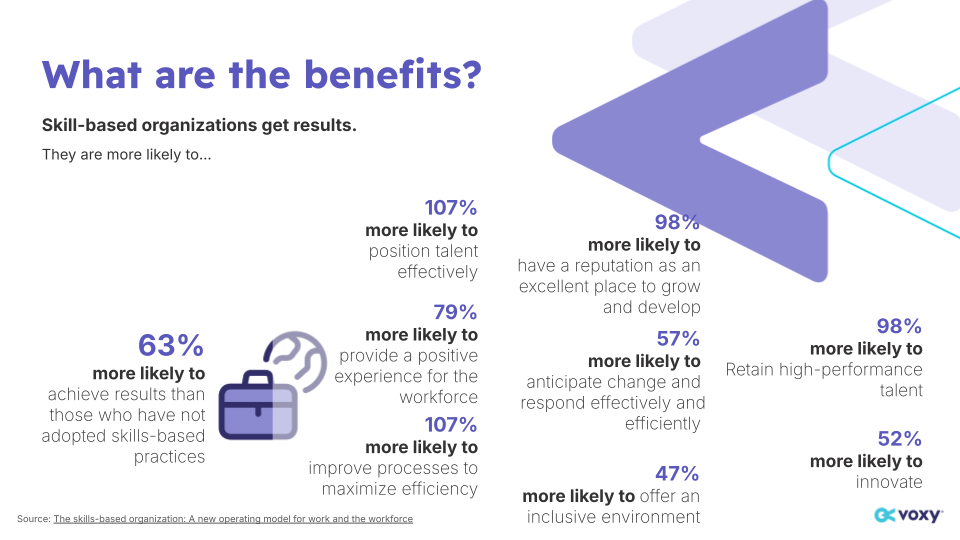
This shows that these organizations are creating structures that better meet both the demands of the market and the expectations of today’s workers.It is these organizations that are adept at placing talent effectively, retaining high-performing employees and creating a truly inclusive and diverse environment. This is because, by fostering an approach based on skills and potential, they no longer focus solely on positions and experience, but promote hires that are better aligned with what individuals can really offer.
Hard skills vs. Soft skills
Skills-based organizations emphasize two main types of competencies: technical and interpersonal, both of which are essential for performance in a competitive and rapidly changing market.
Technical skills: The so-called hard skills are specific competencies related to the use of technologies, processes and tools. In an increasingly digital world, mastering these skills is indispensable for operation and innovation in companies. Examples include:
- Digital literacy: Knowing how to use software and online platforms effectively is essential for most roles, regardless of the sector;
- Data management: With the rise of big data, professionals capable of interpreting and using information for strategic decisions are in high demand;
- Specialized technical knowledge: Industries such as health, technology and engineering require advanced and constantly updated technical skills.
Why are they important? Technology has redefined and continues to define tasks in all areas. Roles once based on operational activities now require professionals who understand complex systems, automate processes and bring insights based on data. Interpersonal skills: So-called soft skills, recently renamed power skills, have become indispensable in the corporate environment and are often seen as a team’s competitive differentiator. Examples include:
- Empathy: Understanding the needs and feelings of colleagues and clients promotes stronger relationships and satisfactory results;
- Collaboration: Teamwork is essential for dealing with interdisciplinary projects and solving complex problems in an integrated way;
- Leadership: In a world of constant change, leading with purpose and strategic vision is vital for engaging teams and achieving goals;
- Adaptability: The ability to adjust quickly to new conditions is essential in unstable markets.
And why are they also important? Interpersonal skills enhance the ability to interact, communicate and solve problems in diverse and global teams. As companies face challenges such as remote management and cultural transformations, these skills become important for adapting to this operating model.
In this way, companies not only prepare their employees for current demands, but also create teams capable of innovating and adapting quickly to new realities in the future.
Striking the right balance
While technical skills guarantee mastery of tools and processes, interpersonal skills are the link that connects teams, resolves conflicts and drives collaborative innovation. This balance is what differentiates organizations capable of thriving in a scenario of constant change.
A study pointed out that 72% of executives consider soft skills to be more valuable than technical skills in the current context. This reflects the need to find complete professionals who combine specialized knowledge with high emotional intelligence.

Meanwhile, in the real world…
Unilever, the global consumer goods giant, is also leading the transformation by adopting a skills-based approach, putting skills at the heart of its organizational strategy. Instead of treating roles only as defined positions, the company has come to understand each role as a set of skills necessary for success within the organization.
Strategy Implemented: The global giant initiated an innovative internal mobility and talent management model, introducing an internal talent marketplace that allows people to move fluidly between different projects and tasks, all based on the skills they possess. This applies to both permanent employees and so-called “U-Workers” – workers who are hired for short-term projects.
- Vision of skills, not positions: The organization has begun to rethink positions, treating them as a combination of skills rather than simple job titles. With this, the company is able to identify the specific skills needed for each task and allocate employees with greater strategic precision;
- Division of work into projects: Unilever’s organizational structure is being progressively reorganized, with work being divided into projects, tasks and deliverables, rather than being limited to traditional departmental functions. This redefined specific approach allows for a better allocation of talent, based on skills and results, rather than length of service or position.
- Internal mobility and strategic recruitment: Focusing on skills and results has allowed the company to recruit in a more targeted way, improve internal mobility and apply the right talent to the right tasks and projects, accelerating business performance.
The impact of this transformation has been evident, allowing Unilever to maximize the potential of its employees, boost organizational performance and increase flexibility in talent management, ensuring that the right people are always working on the most important initiatives for the company’s success.
Where to start and how to implement this trend?
The challenges
Despite the clear benefits, deploying a skills-based model brings a series of challenges that need to be tackled with strategic planning and the incorporation of the right tools. The mapping of soft skills is one of the biggest obstacles, since these competencies, such as empathy, adaptability and emotional intelligence, are subjective and difficult to quantify objectively. Unlike technical skills, which can be assessed through tests and certifications, soft skills require an exceptionally complex and personalized approach, which can include continuous feedback, self-assessments and performance evaluations by team leaders and peers.
Another significant challenge is resistance to change. Companies with distinctively traditional structures can find it difficult to abandon practices based on diplomas or experience from previous positions. The organizational mindset is often based on old concepts, such as the idea that work experience or an academic qualification are more important than the practical skills an employee can offer. To overcome this barrier, it is essential that companies invest in an organizational culture, promoting a mindset focused on continuous learning and the development of skills throughout a career.
Additionally, the lack of adequate tools to effectively measure, manage and develop skills can be an impediment to the successful execution of this approach. Many organizations still don’t have skills assessment systems that combine both technical and interpersonal skills. This makes it quite difficult to identify gaps and create personalized training plans. To solve this problem, companies can adopt platforms such as Voxy, which allows organizations to map and develop critical skills in their employees, offering training and language learning trails in a personalized way, with continuous training programs, real-time feedback and progress monitoring tools.
Finally, the implementation of skills-based models can also require an investment in training and assessment platforms. However, the long-term benefits, such as increased productivity, team building and talent retention, outweigh this initial cost. Companies that invest in developing their employees’ skills report not only improvements in internal performance, but also an increase in customer satisfaction, as better-prepared teams are able to deal efficiently with market demands and expectations.
The solutions
Use of technological tools: Platforms such as Voxy make it possible to integrate technical and interpersonal assessments, creating personalized learning paths that address specific gaps.
Large-scale training: Companies that have used the SBO model show that investing in comprehensive training, combining soft skills and technical competencies, generates tangible results. Training can include anything from face-to-face workshops to gamified modules that engage employees.
Recognition and certification: Implementing certification systems, such as soft skills accreditations, helps employees understand and improve their competencies. These credentials also increase internal mobility and the perception of value for the employee.
Strategic alignment: Make sure that skills development is aligned with organizational goals. For example, if the company’s focus is to expand globally, invest in training that promotes multicultural communication and emotional intelligence.
Why are skills-based organizations crucial?
After understanding what it is and why we’ve seen this trend grow so much in recent years, one question remains: why are they crucial?
Economic impacts and competitiveness
Investing in a skills-based model is not just a trend, but a long-term strategy for improving a company’s competitiveness. By focusing on the continuous development of employees’ skills, companies are well equipped to face market fluctuations and rapid changes. According to Deloitte, companies that apply skills-based practices can see an increase of up to $90,000 in annual revenue per employee in medium-sized companies. This increase is directly related to the ability to use human capabilities within the organization, with employees who are not only qualified, but also prepared to innovate, solve problems and deliver superior results.
Moreover, investment in skills is not limited to internal productivity. The ability to align employee skills with company goals allows for greater innovation, as employees are empowered to think creatively and apply their knowledge strategically. This makes organizations agile, capable of adapting quickly to market changes, making informed decisions based on data and practical skills. Adaptability, which is one of the key skills that companies need to cultivate, makes organizations resilient in the face of crises, such as the COVID-19 pandemic, which forced many companies to reinvent themselves quickly.
Practical example: Microsoft adopted the practice of skills assessment and continuous development for its employees. As a result, the company experienced a significant increase in innovation of products and services and greater competitiveness in the technology market, with new launches and solutions more in line with market needs.
In addition, the rise of artificial intelligence and automation puts an increased pressure on organizations to provide their employees with skills that go beyond the simple execution of tasks. Soft skills, such as collaboration and effective communication, are becoming exceptionally valuable, as they are difficult to automate and have a major impact on team dynamics and customer interactions. Employees with these skills can make it easier to adapt to new technologies, lead cross-functional teams and provide creative solutions in a constantly changing environment.
Practical example: Companies such as Amazon and Google have demonstrated how rapid adaptation to new technologies and the evolution of employee skills can be a competitive differentiator. Amazon, for example, has invested heavily in upskilling and reskilling programs, allowing its employees to adjust quickly to increased automation in its logistics operations, without losing the ability to create value in complex functions, such as project management and product innovation.
Diversity and inclusion
By establishing a skills-based model, companies have the opportunity to create highly diverse and inclusive work environments, as they are not limited to traditional criteria such as degrees and previous experiences. Instead, the focus is on the real skills that employees bring to the organization, which reduces biases in recruitment and promotes a more equitable working environment. The search for practical skills allows companies from different sectors to discover talent in unexpected places and contexts, promoting an inclusive environment.
Studies show that companies with diverse teams tend to be particularly innovative and resilient, as diversity of thought and experience leads to creative solutions to complex problems. In addition, employees who feel recognized for their skills, rather than their academic credentials, are remarkably engaged and are more likely to stay with the company longer.
Practical example: Salesforce is an example of a company that has implemented skills-based practices to promote gender and racial diversity. The company has strived to create an environment in which employees are evaluated and promoted based on their practical skills rather than their educational or historical background. This has helped Salesforce increase representativeness in leadership positions, making its teams significantly diverse and better prepared to understand the needs of a global market.
From hiring to development: the ideal model
Skill-based hiring: hire for potential
Skill-based hiring transforms the selection process. Instead of looking for candidates with impeccable CVs, the focus is on competencies and learning potential. This reduces recruitment costs and results in teams that are inherently aligned with organizational challenges.
Upskilling and reskilling: develop internal talent
Retraining internal talent is notably cost-effective and strategic than replacing employees. Studies indicate that companies that invest in reskilling have 40% higher retention rates.
Training and development trends for 2025
The transition to a skills-based approach is shaping the future of corporate training. Studies show that 90% of executives already engage in skills-based practices, profoundly altering the way they hire, train and develop teams. Mapping skills, developing personalized learning paths and integrating digital tools are the starting point for an effective operation. Companies that invest in this model today will be well equipped to address the challenges that will arise in the future, with teams that are not only prepared for the market, but also capable of shaping it.
The role of tools in skills development
To adopt a skills-based model effectively, companies need tools that centralize technical and interpersonal development. Voxy is one such solution, offering language training tailored to the needs of each role.
- Personalized learning paths;
- Metrics for continuous assessment;
- Integration of interpersonal and technical skills on a single platform.
Finally…
The real question is not whether skills-based transformation is necessary, but rather what will your company’s position be in this scenario of continuous innovation? Prepare for the future. Invest in the skills of today to dominate the market tomorrow. Acquiring a skills-based model is not just a trend; it’s a strategic imperative for companies that want to thrive in a dynamic business environment. This model promotes inclusion, innovation and resilience, helping companies overcome challenges and take advantage of new opportunities.
Voxy offers work-specific language training that can unlock your team’s potential. Our digital solution powered by AI and microlearning improves team communication and produces better results. Book an evaluation today.