
Recent data highlights that over the next five years, 75% of recruiting professionals anticipate a significant increase in the internal mobility rate within organizations’ hiring strategies.
Through internal mobility, employees can grow and advance their careers within an organization, which helps companies maximize workforce potential.
According to the Linkedin Learning Report, the top motivation for people to learn is to progress toward career goals, and internal mobility is key to turn upskilling strategies into growth for the workers and the organization.

Some organizations don’t have a culture of internal mobility, while other companies don’t have positions for current employees to move into. Other barriers to successfully implementing internal mobility include the lack of effective processes, skills mapping and talent visibility.
Organizations do have the power to overcome the obstacles of increasing internal mobility rates to better retain employees, improve performance, fill roles faster, and save time and money.

Ways to Improve the Internal Mobility Rate
Companies have the potential to overcome challenges and boost internal mobility rates by consistently employing appropriate strategies.
This not only increases employee retention but also enhances performance, innovation, streamlines vacancy filling, and results in time and financial resource savings.
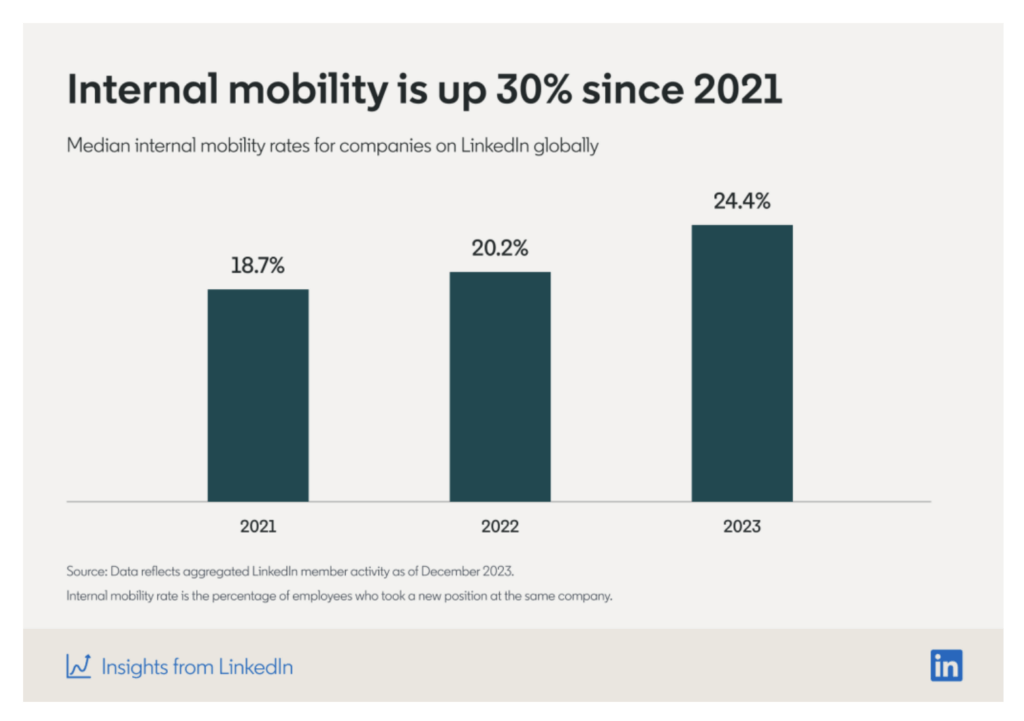
According to LinkedIn, the internal mobility rate has been consistently growing in companies over the past few years, demonstrating that having an internal talent pool ready to tackle new challenges within the organization is a successful strategy.
#1 Prepare your leaders to let go of really good workers
High performance workers usually thrive on solving business challenges and are eager to understand the organization as a whole. But are the leaders ready to see their top performers move on?
By outlining a detailed strategy that highlights the benefits of internal mobility and proactively tackles potential worries, you can encourage your leadership team to embrace the concept of allowing high-performing employees to transition into different roles within the organization.

Propose running small-scale internal mobility initiatives as a trial and constantly gather feedback and metrics to demonstrate the effectiveness of the program, making it easier to gain buy-in for larger-scale implementation.
#2 Nurture a coachability culture
A coachability culture involves fostering an environment where feedback is constructive, learning is continuous, knowledge sharing is a constant and everyone sees the value in both giving and receiving coaching and mentoring.
It contributes to a more dynamic and agile workplace, where individuals feel empowered to take ownership of their growth and development and are motivated to contribute to the organization’s success.
In a coachability culture, workers are open-minded about receiving constructive criticism or feedback on their work. They see it as an opportunity to improve rather than a negative judgment.
#3 Go beyond leadership positions
Many companies prioritize internal mobility as a way to develop leaders, granting those in leadership roles exposure to different organizational functions and departments.
However, for a program to effectively identify top performers at all levels and in various departments, the internal mobility strategy must be inclusive, catering to the diverse career development requirements of employees throughout the organization.
A holistic internal mobility plan not only fosters individual growth but also bolsters the company’s talent pipeline as a whole.
#4 Invest in language training
Internal mobility for global enterprises includes opportunities in other countries and divisions, posing special challenges related to communication and culture.
Investing in an evergreen language upskilling program can yield many benefits that can significantly contribute to global growth within an organization, such as:
- Enhanced communication, allowing teams to collaborate more effectively across borders with less communication barriers. Clear communication fosters better understanding, efficiency, and teamwork, facilitating smoother global operations.
- Fluency in local languages opens doors to internal mobility to new markets. Employees who can speak the language of target markets are more culturally intelligent, can build deeper connections and understand customer needs better, leading to better rapport and business outcomes.
- Openness for innovation and diverse perspectives, since different language skills leads to access to more knowledge, fresh ideas and unique problem-solving approaches.

#5 Offer temporary opportunities
Sometimes, an organization has no vacancies, making internal mobility stagnant and affecting employee satisfaction. One solution is to offer temporary job opportunities, such as short-term projects and gigs.
Temporary positions and job rotation programs offer employees an opening for professional development and a chance to learn new skills.
Temporary movements also help teams to prepare and rearrange to function without the people that are seizing opportunities in other divisions or departments.
#6 Over-communicate
When starting initiatives to improve the internal mobility rate, avoid running them only within the HR department and the leaders of the workers involved.
Choose a memorable name for the program and communicate the rules clearly, notifying all employees of the opportunities, how to apply and the next steps, providing a contact person in human resources.
Over-communication is a powerful tool for organizations to build a strong workplace culture and build trust between leadership and employees.
Internal communication also allows leaders and employees to provide feedback, such as voicing concerns and celebrating successes. In turn, people feel valued, heard, and appreciated.
#7 Double down on skills-based practices
In the past, organizations focused solely on education and work experience when hiring internally or externally. However, recent years have seen a shift towards skill-based practices as the optimal method for recruitment and development.
A skills-centric approach to hiring is a big trend, expands the talent pool and boosts internal mobility rates by eliminating unnecessary job requirements and focusing on the skills that will really move the needle.
By delving into an organization’s internal talent pool, it becomes simpler to assess individual employees’ skill sets. Skill mapping empowers managers to pinpoint gaps within their teams and match the right employee to fill those gaps effectively.
Employing skill-based training ensures a pool of high-quality talent ready to occupy essential roles. This training can encompass courses spanning technical skills, communication, leadership, diversity and other relevant skills, ensuring a well-rounded workforce.
Final thoughts
The evolving landscape of internal mobility signifies a critical shift in the way organizations cultivate talent and propel their growth trajectory. Embracing a skills-centric approach to hiring and fostering a culture of continuous learning not only accelerates internal mobility rates but also cultivates a workforce poised for success in a globalized world.
By breaking down barriers, embracing diversity in talent development, and investing in language training and skill enhancement, organizations pave the way for seamless collaboration, innovation, and market expansion.
The journey towards improving internal mobility rates is not solely about filling roles; it’s a strategic investment that enhances employee satisfaction, drives organizational performance, and propels sustainable growth in an ever-changing business environment.
As companies prioritize skill development and adaptability, they forge a path towards a future where every employee’s potential is unlocked, and the organization thrives on the strengths of its diverse and agile workforce.
Voxy supports corporate customers in over 150 countries with access to live language coaching led by certified teachers and an extensive library of role-specific courses that fill crucial soft and technical skill gaps. Contact us at Voxy for a 15-minute assessment of your organization’s needs.