

A training needs analysis that makes a real impact is essentially the difference between the skills workers possess and those required to achieve the company’s goals.
Though it seems simple, it’s an extremely complex process, especially for large companies. In this article, we’ll discuss the main challenges and solutions to develop a training plan aligned with the essential needs for organizational growth.
Challenge: Assessing Team Skills
To identify training needs, it’s crucial to develop a process to map out workers’ skills.
Especially in large companies, the diversity of profiles and roles complicates this process. The skills required in production greatly differ from those needed in administrative or commercial areas, for instance.
An increasing trend in large organizations is the skills-based organizational model, which views work as a set of skills rather than relying on roles that require extensive qualifications.
According to Ryan Roslansky, CEO of LinkedIn, skills currently hold more relevance than diplomas.

According to a Deloitte survey involving over a thousand HR professionals and executives globally, 90% of executives are adopting skills-based practices to prepare organizations for the future, changing how they hire and develop their teams.
Solutions:
- Development of skills frameworks that identify essential skills for all workers, regardless of location or role.
- Periodic assessments and structured interviews to understand employees’ skills, goals, and growth expectations. Often, those who experience day-to-day work make better contributions to the development plan.
- Collaboration forums between departments and business units to identify training needs and cross-training opportunities, such as those focused on diversity, which can benefit a large group of people.
Challenge: Speed in the evolution of demanded skills
Just when we thought we had mastered the essential skills for good job performance after the digital transformation, generative artificial intelligence stepped in to further accelerate skill transformation.
According to a World Economic Forum survey with global organizations, 44% of participants indicated that skills required in the workplace will undergo disruptive changes in the next five years.
Solutions:
- Adoption of talent management systems that allow continuous and automated tracking of performance and skills taxonomy to facilitate data-driven decision-making for a more effective training plan.
- Fostering a culture of lifelong learning that inspires people to be curious in seeking solutions for the organization, supported by company incentive practices such as education budgets and data-driven training plans.
Challenge: Alignment with business needs
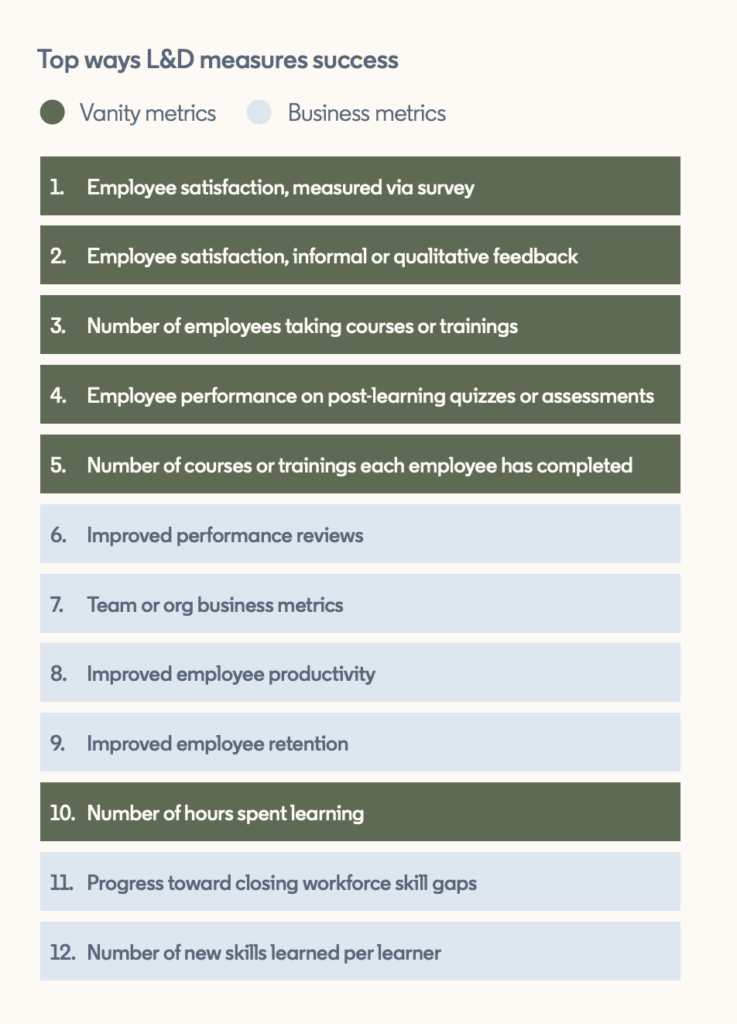
At the top of the priority list for training professionals, as indicated in the LinkedIn Learning Report, is the quest to align the training plan with business demands.
However, when asked which metrics are used in managing training programs, the vast majority of the metrics mentioned are “vanity metrics” based on how much people liked the training.
Solutions
- Strengthening connections with C-level managers and executives is crucial. This helps establish your position not only as a training provider but as a strategic business partnership.
- The lack of ROI measurement in training and development can result in inadequate resource allocation and missed opportunities for growth and success. According to a survey conducted by Voxy, involving over 350 HR professionals, only 11% of organizations are measuring ROI in training.
- Training programs that utilize technologies like artificial intelligence to consider job needs and each worker’s preferences to create personalized training plans.

Challenge: Soft skills mapping
Soft skills (recently renamed power skills) are in high demand. A study by Deloitte predicts that by 2030, two-thirds of all jobs will be occupations requiring interpersonal skills.
Over time, leaders recognized that these valuable skills help people adapt, enhance their decision-making abilities, and become more innovative.
The challenge in mapping training needs is that, although crucial for organizational success, soft skills like communication, unlike technical skills, are harder to acquire, take longer to develop, cannot be easily transferred, and are difficult to assess, identify, and teach.
Moreover, the advancement of technologies like artificial intelligence and machine learning has made acquiring and automating technical skills easier. However, this demands greater flexibility and analytical capacity from professionals.
Solutions
- Encouraging lifelong learning: Soft skills empower workers to quickly adapt to a constantly changing environment, fostering resilience and curiosity. Collaboration and knowledge-sharing are strengthened when the organization actively strives for continuous improvement in workers’ interpersonal skills.
- Actively recognizing and highlighting diversity and cultural multiplicity in the organization. Modifying programs to be inclusive and respectful of different cultural contexts, as proximity to diversity contributes to workers’ growth.
- Fostering a feedback culture, where individuals feel the organization is a safe space for new ideas, perspectives, and debates that contribute to business growth beyond hierarchy. With feedback integrated into daily life, individuals can reflect on areas for improvement.

Challenge: Differences in skill levels
Frequently, companies have diverse teams with varying skill levels, roles, and learning preferences. Adapting training programs to meet the diverse needs of employees can be complex.
For instance, a multinational company might decide to implement an evergreen language upskilling program so that workers have more opportunities for mobility and internal recruitment in global positions. However, they might encounter difficulties setting the groups, regardless of their position, may have significantly different skill levels.
Solutions
- Training programs on platforms that assess demands and knowledge levels at the program’s outset, utilizing personalization with technologies like AI to offer each person content that’s relevant to their skill level.
- Encouraging employee participation in the training adaptation process, allowing them to express their needs and suggest more effective and engaging learning methods.
Conclusions
An efficient analysis of training needs is the difference between the skills workers possess and the skills necessary to achieve the company’s objectives.
Assessing workers’ competencies, aligning with the rapid evolution of required skills, and integrating training programs into business objectives are some of the key challenges.
Solutions like global competency frameworks, innovative technologies, and a feedback culture are promising strategies to overcome these obstacles.
As soft skills gain importance, adapting training programs for teams with different skill levels is a challenge. Customized strategies, involving workers in the adaptation process, and AI technologies to adjust to knowledge levels are ways to tackle this complexity.
Addressing these challenges requires comprehensive approaches, from gathering accurate data to creating a culture of lifelong learning and strategic alignment with corporate objectives. This is the path for organizations to have teams ready for challenges, both now and in the future.
Voxy is a language platform focused on the business needs of teams and organizations, with certified instructors specialized in job skills, available for short classes accessible from any device. Schedule 15 minutes with Voxy to discuss your team’s demands.