
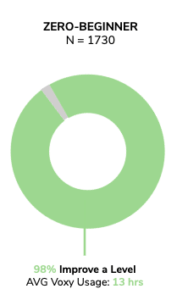
One of the questions I get asked all the time about Voxy is whether or not the platform is appropriate for beginners. And I understand why people ask this: Our platform is largely in English, and learners at all levels encounter real-world examples of English in action, which means that they will always be seeing words they haven’t yet learned. We know that this can seem overwhelming and even frustrating, especially for new learners, and so we spend a lot of time explaining that this really is the right approach.As we’ve pointed out before, for novice learners, picking up a new language is often really, really hard, especially at first. That’s because learning a language is learning a new skill, and, objectively, that is hard for adults to do. Think about learning to do any new skill as an adult, from skiing to cooking to playing the piano. At the beginning, you are overwhelmed, possibly frustrated, and making lots of mistakes, which is exactly what is happening when true beginners start using Voxy. But that’s how we know it’s working, as it is also what happens when true beginners start learning English, no matter what the instructional approach. It’s kind of like going to the gym–if you’ve never been before and it feels easy, then you probably aren’t doing very much. The truth is that there is no way around making mistakes, being uncomfortable, or not understanding what is happening. If those things *aren’t* happening, then it’s very unlikely that real language acquisition is happening. The good news, though, is that those first uncomfortable days tend to end pretty quickly, and novice learners on the Voxy platform find that they are speaking and understanding some English after just a few hours of practice. And you don’t have to take my word for it. Year after year, we measure how long it takes Voxy learners with absolutely no prior language learning experience to move from being complete novice learners to being able to introduce themselves and use familiar, everyday phrases. In 2017, we looked at over 700 learners who had no prior experience with learning English, and we found that 84% of them improved a level after an average of 14 hours (see Figure 1).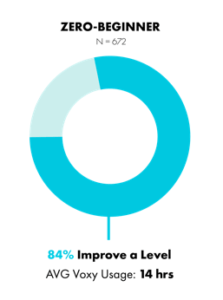 And in 2018, with a larger sample size, we had even more successful novice learners (see Figure 2).
 As I’ve said before, this is a case where setting expectations is more than half the battle. When everyone understands that a little confusion and uncertainty is actually a necessary part of the language learning process, getting started does not seem so bad. The data speak for themselves–the Voxy platform is appropriate for beginners, and our immersive, English-only approach gets them up and running quickly.