
We have been conditioned to think that language is only a tool we use to describe and communicate the world around us, and you can use many different tools (languages) to describe only one world. But does the world change in accordance with the ‘tool’ you use?
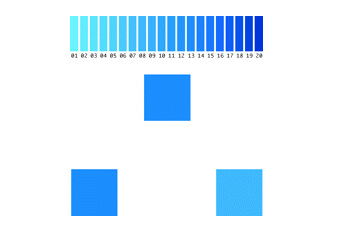
That’s an interesting topic brought up by a study published in 2007 by Jonathan Winawer (MIT) et al. Such study involved a group with native English speakers and a separate group with native Russian speakers. They were presented with blue squares that differed in shades from light to dark blue, with one of them being used as the main matching reference to the others, just like shown in the main picture of this article. When prompted, participants had to quickly choose which shade of blue matched the reference square. Seems very easy, doesn’t it? Well, one fact worth mentioning is that, in Russian, light blue and dark blue are actually considered to be two totally different colors, with two completely different names (lighter blues are “goluboy” and darker blues are “siniy”), much like if you were to compare orange to red.
As you would expect, Russian speakers found it very easy to distinguish between light blue and dark blue and were faster than English speakers when doing so. English speakers treated comparisons between different color categories (shades of light and dark blues) and comparisons between same color categories (shades of light blues only/ shades of dark blues only) with the same level of difficult, while Russian speakers showed some advantage in the first type of comparison. Even though language was a determinant factor, the study did not involve language at all. We can also generalize it and say that the way people use language determines how they perceive the world and changes their conscience.
Subjects were additionally analyzed for their ability to perform the same task described above with an extra distraction of silently rehearsing an specific string of numbers, such as “1,8,6,7,2,5,4…” As such a task demands linguistic attention from the individual (digit strings are not easily memorized without linguistic help, hence the way we memorize telephone numbers), the advantage shown in the first trial was not mirrored on the second one. A third control trial was performed to make sure that this effect was not only caused by “having to do two things at the same time,” but rather caused by the fact that these two tasks mentioned above overlap linguistically.
This study suggests that, after all, language may not only be treated simply as a code or a tag we put on elements and established concepts. Language may also create these elements and establish itself new concepts and how Humans perceive them. It may also serve as an explanation of why there are so many untranslatable expressions between languages.