You probably remember that kid from high school who was always shuffling through his scribbled-upon notecards before a big test. Perhaps you were (or are) that kid. Flashcards – both the traditional and digital types – have become the subject of much debate among educators. So are they actually an effective learning tool?
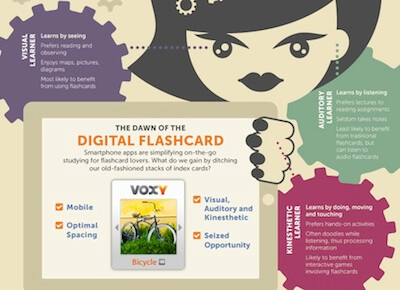
The infographic below was inspired by the recent launch of our new iPhone app featuring photo flashcards. In it, we take a look at several of the benefits that go hand-in-hand with this form of study, as well as some of the criticisms raised by the ELT community.
Where do you stand? Are you a flashcard friend or foe? Ready, set, debate!


About The Research Behind This Infographic
In addition to using the sources listed on the infographic, we anonymously polled 175 language teachers and students about their views on the effectiveness of flashcards. To explore the feedback we received, download the flashcard poll summary [PDF].
Use This Infographic In Your Class
We think that infographics are an awesome learning and teaching tool, so our creations will always be available for you to print out, use with your students and embed on your blog!
[embedbox https://voxy.com/blog/wp-content/uploads/2011/05/voxy-infographic-are-flashcards-effective-565×3531.jpg]Warm-Up Discussion
Before handing out the infographic, discuss the following questions with your students:
Flashcard Preferences
- Do you ever use flashcards?
- Do you think that flashcards are an effective learning tool? Why or why not?
Learning Styles
- Do you believe in learner types – e.g. that some people learn better by seeing, others by listening and still others by doing?
- How do you learn best?
Listening Activity
Have your students watch and listen to Kirsten Winkler’s interview of Greg Detre from Memrise on the neuroscience of flashcards. Ask them to jot down all of the reasons why Detre thinks that “flashcards are great.” Once students have finished viewing the video and putting their thoughts on paper, compile a complete list of reasons on the board. Ask your students whether they agree or disagree with what they have heard in the video.
Speaking & Critical Thinking Practice
- Why is studying with flashcards such a popular technique?
- What goes on in our brains when we use flashcards?
- Explain why it’s important to always space your studying.
- Interpret the following quote as it relates to learning a language with flashcards:
“Vocabulary knowledge is largely a question of accumulating individual items.” -Scott Thornbury - Summarize the arguments against the use of flashcards. What points, if any, would you add to this list?
Writing Challenge
Ask your students to write an essay or blog post in which they comment on the debate surrounding the effectiveness of flashcards as a learning and teaching tool. In addition to discussing their personal experiences, they should reference the infographic and the feedback from our anonymous ELT poll about the effectiveness of flashcards.
For more ideas on how to use infographics in your classroom, take a look at the New York Times’ Data Visualized: More on Teaching With Infographics.
Related Blog Posts, Articles and Links from the field of ELT
- Eva Büyüksimkeşyan outlines 10 activities you can do with flashcards
- The British Council offers an array of flashcard activities for young learners
- Sean Banville has gathered up 42 websites on using Flashcards
- Chiew Pang demonstrates activities involving mobile phone snapshots
- David Read talks about personalized dictionairies on mobile phones
- Nik Peachey offers tips on making pronunciation cards
- Ceri Jones discusses working with images from the students’ worlds
- Karenne Sylvester offers tips on scaffolding emergent vocabulary
- Scott Thornbury discusses the importance of situation and “bringing the outer world ‘into’ the classroom”
- Barbara Sakamoto shows the value and importance of context
- Larry Ferlazzo runs through some of the best tools to make online flashcards