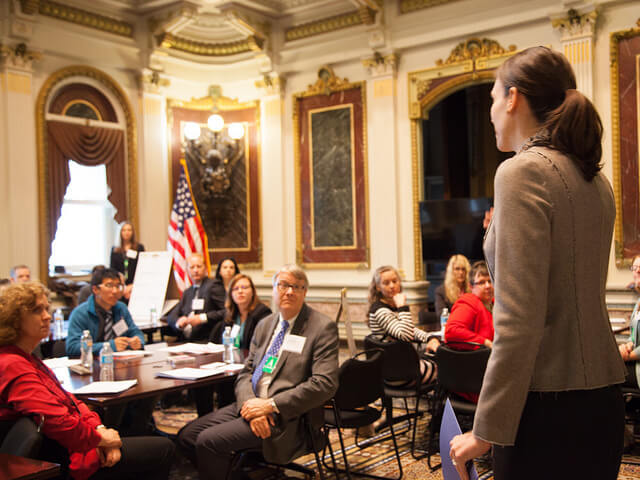
Voxy’s Chief Education Officer, Dr. Katharine B. Nielson, PhD, was invited back to the White House last month to participate in an event called English for All: Technology in English, now in its second year. Voxy was one of just five private-sector organizations represented; others included Newsela, Global English, Voice of America’s Learning English and Digital Promise.
English for All was originally created to spark a dialogue across disciplines on English language learning and educational technology, and this year’s forum was focused on the American English E-Teacher online platform and scholarship program. One of the main goals of this program is to promote democratic access to education and teacher training, with an emphasis on low-resource areas across the globe.
Because digital resources are inconsistently distributed and prohibitively expensive in some places, there are significant challenges in providing education to both learners and teachers. Did you know that in 2014, only 19% of people in Africa had Internet access, compared to about twice that in Asia and more than four times that in the U.S.? Or that in Egypt, there about 28 million Facebook users, but only 800,000 in Bahrain? These vast discrepancies in Internet and mobile access, preferred social media platforms and limited access to information under restrictive governments can result in major barriers to education around the world. English proficiency is one of the most significant factors affecting economic mobility, but without access to quality instruction online, many lack the resources they need to learn the language.
Furthermore, English teachers themselves are often short on adequate training. Teachers need to learn how to leverage new technologies in the classroom, many need to improve their own English proficiency and there’s a gap in collaboration between teachers who are credentialed and those who are not.
“One of the most exciting parts of the event was getting to hear from the Regional English Language Officers about the different challenges that students and teachers face and how dependent those challenges are on context and region,” said Nielson. “Finding a way to take advantage of the benefits that technology can bring to the language-learning process—while at the same time meeting the needs of learners in parts of the world with limited access to electricity, let alone Internet connectivity—is an exciting opportunity for this working group.”
English for All addressed these issues during a “hackathon,” where small groups were tasked with brainstorming prototype products that could solve problems in the English learning space. For example, Nielson’s group worked on a plan to engage students and teachers through social media and considered ways that social media could be incorporated into the classroom. The ideas generated in these sessions will be piloted by Iowa State University as part of their e-teacher online course in educational technology.
Voxy also offers an online teacher training course called “Teaching English: Pedagogy and Best Practices,” designed to teach instructors the most effective approach to second language acquisition (SLA) for teens and adults.
One of the key takeaways from English for All is the clear potential for collaboration between the public, private and nonprofit sectors to improve the way technology is used for English teacher training around the world, and for empowering English teachers to use technology in ways that will resonate with learners and improve their ability to teach efficiently and effectively.
English for All: Technology in English was made possible by the White House Office of Global Engagement and the U.S. Department of State’s Bureau of Educational and Cultural Affairs. Photos courtesy of the Department of State. To learn more, please click here.