

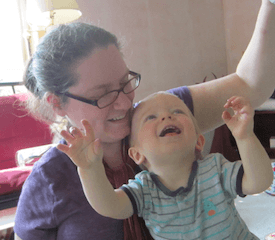
 When my son was born, I was excited to interact with him (after some sleep, that is). We’ve been communicating his whole life, but his speaking didn’t really take off until he was around 16 months, when I noticed a lot of parallels between my son and my English students, some of which matched my own experiences learning other languages.
English learners, take heart! It’s not easy to learn another language, and even native speakers have trouble at first. Here are some tips for communication, inspired by a toddler but helpful for all language learners.
Listening and Pronunciation
Learning vocabulary only by listening is hard
It always helps me to see a word in addition to hearing it. But it does sound awfully cute to hear my son ask to hear “siwik” (music) or eat “granbabies” (cranberries).
Certain sounds are hard to produce, but they don’t have to be perfect
TH, L/R and consonant clusters, particularly those with L/R—think GReen, BLue, TRain and ice CReam—are especially difficult. My son says the word “bathroom” like “bahfum,” but it’s pretty close and easy to understand. He also says “uncle” like “unco,” which is a great substitute for an L at the end of a word. W in place of an R at the beginning of a word is also an okay substitute if you’re having trouble (“wooster” instead of “rooster”).
Your pronunciation improves with practice
This is probably a given, but you will improve as you practice. For my son, “boo” has become “boobewy” (which will someday become “blueberry”), and “suss” has become “horse.” It doesn’t happen overnight, but if you keep listening and practice speaking, your sounds will improve.
Helpful Cues to Help Others Understand You
Gestures and sound effects help
I never would have known that my son was asking for help unless he had used the ASL (American Sign Language) gesture, because when he said the word “help” it sounded just like “up.” He also made an elephant “brrr” noise well before he could say “elephant,” and he regularly points or otherwise indicates objects. Use what you have, even if you feel silly.
Context is everything
“Bunny,” “banana” and “button” sound almost identical when my son says them, but it’s often clear which one he means based on the context—if he’s playing, eating (or if he’s hungry) or touching someone’s shirt, for example. Similarly, don’t expect your teacher to know what word you want to say unless you share more information or the rest of the sentence.
Be creative
If you don’t know a word, substitute something as close in meaning as possible. I was tickled when my son, at about 10 months old, called the wind “fan.” And because he loves vehicles, he called everything “car” for a long time.
A little “please” goes a long way
People (including tired parents) are much more patient when you’re polite. In fact, people will often go out of their way to help. With a few polite words in your arsenal, you can feel much more confident simply because people will be more receptive.
General Tips for Studying
Read…a lot!
At 19 months, my son called a penny “shiny” and his diaper changing pad “squashy.” To the best of my knowledge, he has only encountered those two words in books. He has learned many words for vehicles as well as many sound words, and I often see him reading books on his own, pointing to pictures and saying words. Reading is one of the best ways to learn vocabulary and grammar.
Pay attention
Anything is an opportunity to practice, including hearing an airplane fly overhead or a radio story about big cats. It’s best to read or listen to things that are at or just above your level, because the more you understand, the more energy you have to pay attention, but even something well above your level can help.
Learning a language takes a lot of energy, but confidence comes as much from feeling competent as it does from actual language ability. By using all of your resources, you’ll have the confidence to interact with others. And that’s when it really gets fun!