
Have you been using a generative AI tool like ChatGPT to make your L&D life easier? If not, this might be a good opportunity to start. Harnessing conversational AI in corporate learning can significantly ease your daily workload.
If you’re not familiar with the conversational AI model, you may not be sure what questions and commands will be helpful.
In this article you will find actionable hacks aimed at leveraging generative AI’s potential within corporate learning environments, to simplify tasks and boost overall efficiency.
The future-proof L&D Pro
Although the use of gen AI in corporate training has only become popular recently, the adoption of this technology in HR is happening fast. In a recent survey, 1 in 4 organizations report to be using AI to support HR-related activities.
Regarding professionals who are not yet utilizing AI for HR activities, 42% responded that a lack of knowledge about AI tools is the primary reason and the Linkedin Workplace Learning report states that 4 in 5 people want to learn how to leverage AI in their professional lives.
You can integrate generative AI chatbot tools into your workflow to generate a wide range of content including text, images, and videos, simplifying your daily tasks and enhancing productivity.
When it comes to gen AI, the key lies in asking the right questions and exercising creativity to grasp the potential applications. This approach fundamentally shapes your experience with such tools and helps you future-proof your professional skills.
Research says that office workers dedicate a third of their time to admin work, so incorporating gen AI into your workday will free up time to focus on more important work.
Becoming more strategic and data-driven will help you level up your professional game by aligning the corporate training strategy with the business goals, which is the top priority for L&D leaders.
18 ChatGPT Prompts for Corporate Learning
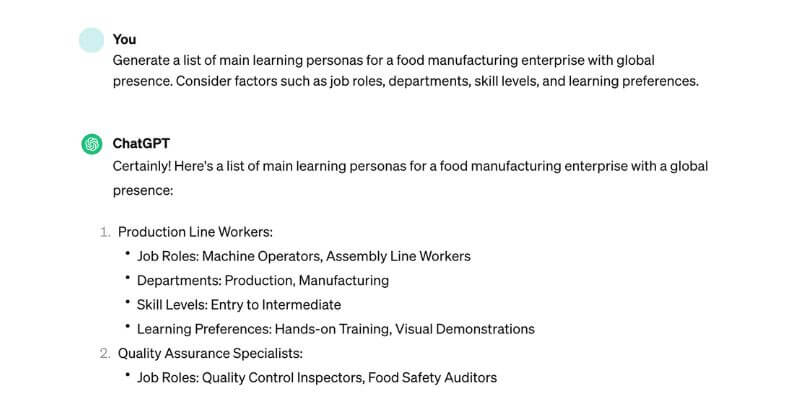
1. Creating learning personas
Generate a list of main learning personas for a [food manufacturing enterprise with global presence]. Consider factors such as job roles, departments, skill levels, and learning preferences.
2. Adapting learning strategy to business needs
Our main company goal is [to expand presence globally]. Provide a list of skills that professionals from the [finance team] should develop to reach that goal.

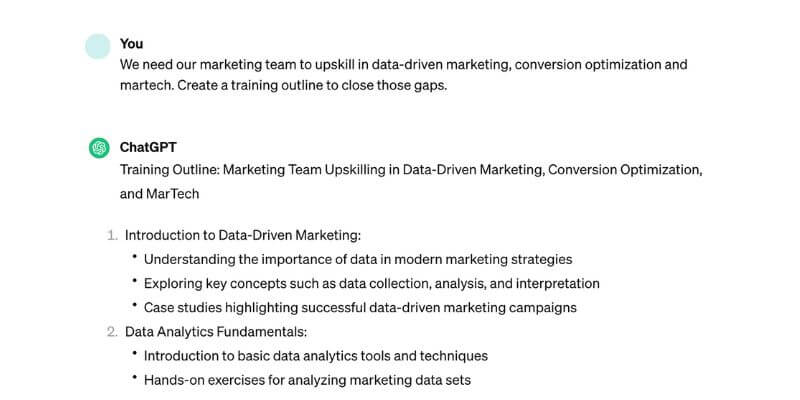
3. Creating a training outline
We need our [marketing team] to upskill in [data-driven marketing, conversion optimization and martech]. Create a training outline to close those gaps.
4. Brainstorming ideas for content topics
Suggest a list of training topics to improve [the financial health of our employees].
5. Simplifying technical texts
Suggest a revised version of the [technical text] below, making it more accessible for non-technical professionals.
6. Localizing content
Localize the text below to Spanish including language and cultural particularities of [Mexico].
7. Getting practical examples
Provide 5 practical examples of daily activities that [language training] can improve in the work performance of a [project manager].
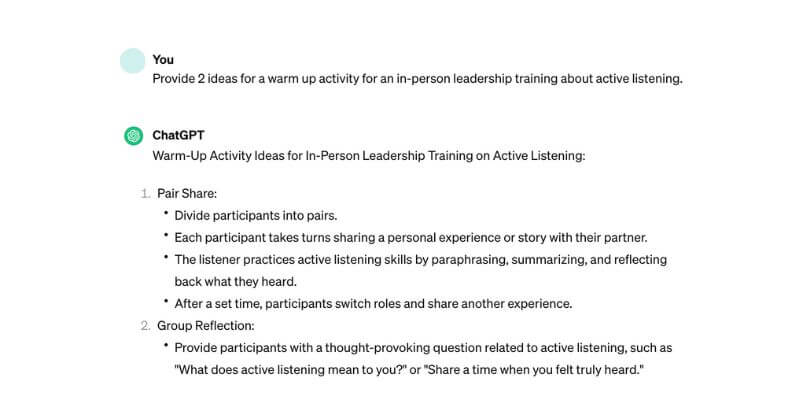
8. Getting ideas for activities
Provide 2 ideas for a warm up activity for an [in-person leadership training] about [active listening].
9. Creating event agendas
We will have a [workshop for the sales team] on a business day from 10 am to 6 pm, including a lunch break and a 20-minute networking break in the afternoon. The training will consist of [three] sessions: [one training session, one role-playing session, and a closing session to recap the day]. Please suggest an agenda for the day.
10. Getting ideas for training program names
We will add a training session about [diversity in the workplace] to our onboarding process. List 10 short name ideas for this training program.
11. Writing training communications
I want to invite all the [developers] in the team to participate in a training session about [effective communication]. Please write an invitation citing the benefits this training can have in this career.
12. Conducting a sentiment analysis on qualitative feedback
Analyze the testimonials below regarding a training session on [customer success best practices] and provide an overall sentiment analysis.
13. Improve training based on qualitative feedback
Analyze the testimonials below regarding [a language upskilling program] and provide actionable feedback for the program.
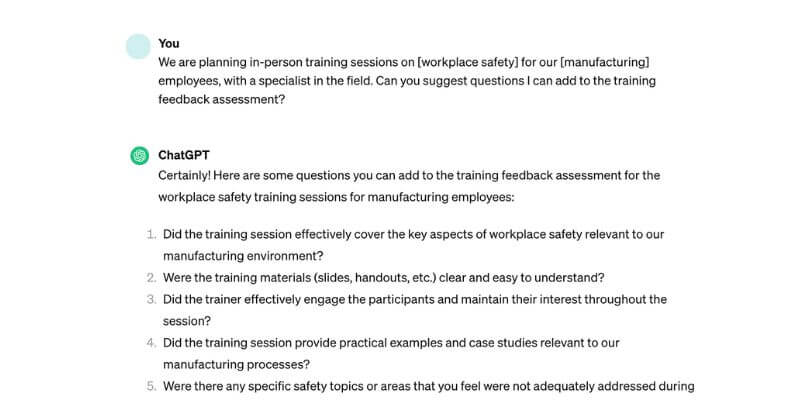
14. Getting question ideas for a training assessment
We are planning in-person training sessions on [workplace safety] for our [manufacturing] employees, with a specialist in the field. Can you suggest questions I can add to the training feedback assessment?
15. Listing skills for job roles
Provide a list of skills that a [marketing operations specialist] must have to [drive revenue growth].
16. Refining the skills required for internal mobility
We are preparing a professional to move from a [client account manager] role to a [sales executive role]. What skills need to be prioritized in the professional development plan?
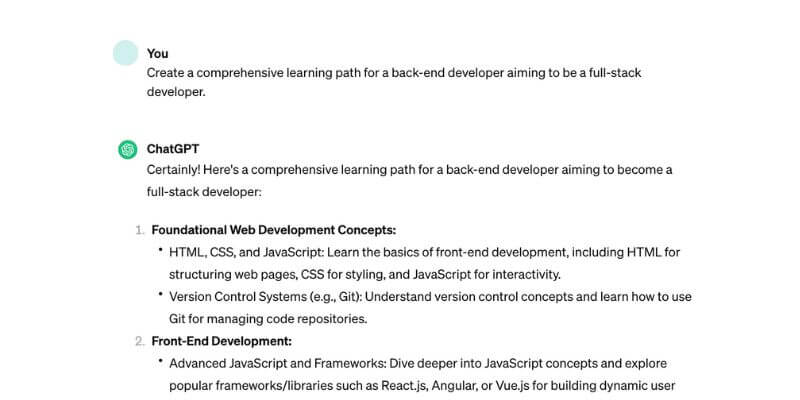
17. Creating learning paths and study plans
Create a comprehensive learning path for a [back-end developer] aiming to be a [full-stack developer].
18. Working on your own professional development
I am an L&D professional, and I want to play a strategic role in aligning the corporate education strategy with the company goals, ensuring good alignment with the team leaders. What skills should I prioritize in my development plan?
How to write effective prompts and commands for ChatGPT
Double down on your analytical thinking skills
Soft skills are becoming increasingly valuable in today’s workforce. Deloitte predicts that occupations requiring strong soft skills (or power skills) will represent two-thirds of all jobs by 2030 (compared to half of all jobs in 2000).
However, alongside the rise in demand for soft skills, there’s also a growing need for analytical and technical abilities to evaluate, adapt, curate, and delve deeper into the outcomes you obtain. This enables you to better harness AI in corporate learning, using tools, and platforms to level up your L&D game.
Work hard to provide the best context
Before giving the command or asking the question, provide the necessary context and establish roles.
Asking the machine to assume roles, making your perspective clear, the size of the organization, and the profile of the role performed by the professional and other details can make a big difference in the quality of information the chatbot will return.
- “I’m a training manager for a manufacturing company of five thousand employees (…)”
- “You are an email copywriter (…)”
- “Keep the text to 250 characters.”
Write down the prompts that provide the best outcomes
Wrote a command that left you in awe with the quality of the answer? Write it down on a document to use it later, separated by categories.
Add some storytelling and examples
Think of generative AI as a partnership to get the job done. Your part in this partnership is to review the generated content to add touches of personality and humanity, citing past programs, participant testimonials, and any other information that gives the team and company’s identity to the content.
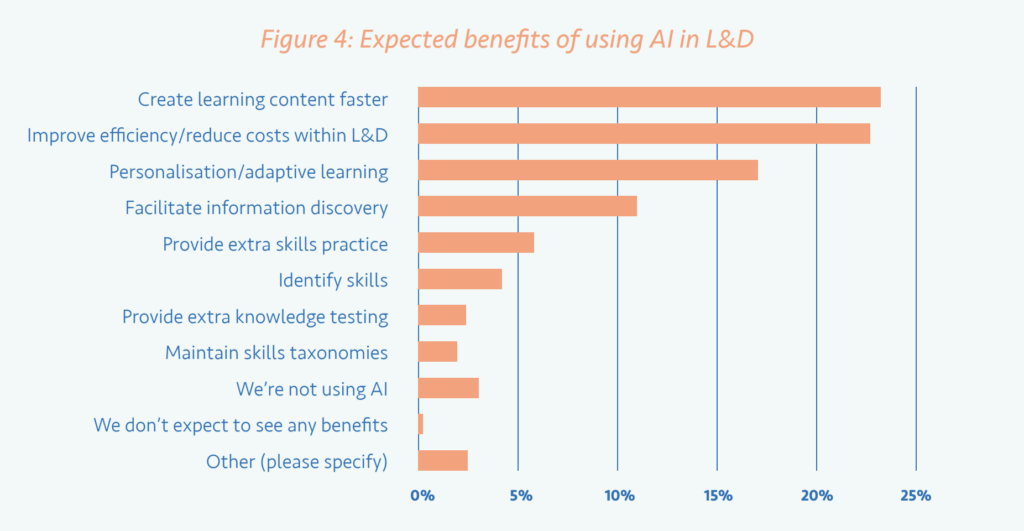
Based on a recent survey conducted with L&D professionals, accelerating the creation of learning content emerges as the primary application of AI. Ensure that your training material maintains its quality and fosters connection and engagement, avoiding any disconnect with the company culture.
Keep in mind that AI is just one tool in the training toolkit. Companies should avoid depending solely on AI and should instead integrate other training methods to ensure a comprehensive and balanced learning experience.
Partner with specialists to understand security hazards
In this study, it was found that 2 out of 5 L&D professionals express concerns regarding the security and privacy of data utilized by AI tools.
As you embark on integrating AI to streamline your L&D processes, it’s essential to address any apprehensions you may have.
Engage with technology specialists and regulatory experts to ensure compliance and mitigate risks associated with data security and privacy.
Beware of biases
AI tools, particularly those employed in hiring processes, must safeguard against bias. It is imperative for both developers and users of such tools to conduct rigorous testing to ensure their ethical use and compliance with discrimination laws.
Additionally, ongoing monitoring and evaluation of AI in L&D are essential to address any potential biases that may arise and to maintain fairness and equity in decision-making processes.
The Future of Privacy Forum developed this guide as a foundational resource for establishing AI guidelines in people technology, making it an excellent starting point for reference.
Final Thoughts
As AI and L&D get closer together, it’s crucial to harness its potential while remaining mindful of ethical considerations and biases.
Remember, AI is just one tool among many in the training toolkit. Strive to maintain a balanced approach, leveraging AI’s strengths alongside other training methods to ensure a comprehensive learning experience.
Additionally, collaborating with specialists to address security concerns and biases is essential for successful AI implementation. By embracing AI strategically and responsibly, L&D professionals can unlock its transformative power to drive organizational growth and employee development.
Voxy uses AI to provide personalized language learning paths and curated content to meet your organizational needs and your learners interests. Schedule a 15-minute call so we can discuss your language upskilling needs.