
When an engineering team ships late, the post-mortem usually points to scope, dependencies, or estimation. The quieter cause, the one nobody puts on the slide, is often communication. A reviewer’s comment that landed wrong. A retro insight that never made it past someone’s second-language hesitation. A handoff between a São Paulo developer and a Berlin product manager that needed clarifying questions and didn’t get them.
In high-performing tech organizations, communication is the medium that engineering work moves through. When that medium breaks down, every other investment in the team, the tooling, the methodology, the talent, pays out less than it should. That’s why Voxy’s Global Benchmark Survey consistently identifies communication as one of the most persistent barriers to collaboration for global teams.
The trouble is that the language training most companies offer their engineers and IT professionals is still designed for a generic business audience. That gap is what specific English training for tech teams is meant to close, and it’s the difference between a program that gets completed and one that actually changes how the team performs.
Why generic English fails tech teams
An engineer running a stand-up needs a different register than a hospitality manager greeting guests. A developer drafting a postmortem needs clear, specific, blameless documentation rather than the polished register of executive negotiation. An IT support lead in a customer escalation needs technical precision and empathetic communication in the same breath, often while the meter is running.
General business English, by design, abstracts away from those specifics. Tech professionals can be conversational in English and still struggle to express the precise difference between “blocked” and “stuck,” to push back on a code review without sounding defensive, or to ask a clarifying question in a global Slack channel without slowing the thread to a crawl.
When training doesn’t reflect those realities, the cost shows up everywhere. Engineering velocity drops as code reviews loop. Onboarding takes longer because new hires can’t decode the team’s communication norms. Cross-border collaboration gets brittle, and the quiet contributors stay quiet. Across time zones, asynchronous communication carries even more of the load, which means written precision and tone matter as much as spoken fluency. For tech teams specifically, the gap compounds. The companies investing in role-relevant English for technology professionals are quietly closing communication gaps their competitors don’t even know they have.
What learning science says about adult language acquisition

There’s a reason role-relevant content outperforms generic content. It comes down to how adult brains learn language.
Decades of research in second language acquisition point to a few stable findings. Adults learn fastest when input is comprehensible and slightly above their current level, when language is paired with meaningful and immediate use, and when there’s enough repetition for new vocabulary to move from short-term recognition to long-term recall. Generic English programs satisfy the first condition reasonably well, and tend to struggle with the second and third.
When an engineer studies vocabulary they’ll use in a sprint planning meeting tomorrow, the language has a place to land. The brain links new words to existing knowledge structures the learner already cares about. Retention rises. Time-to-fluency drops. The same engineer, asked to memorize a generic dialogue about ordering coffee at a hotel, gets none of that lift.
Andragogy, the study of how adults learn, adds another layer. Adults engage most when learning is problem-centered, draws on their existing expertise, and connects to outcomes they care about. A senior backend developer doesn’t want to start from scratch in a beginner business English module. They want to refine the specific things that slow them down: tighter pull request descriptions, presenting architecture decisions, mediating disagreement in a design review. Microlearning built around the right content fits naturally into the rhythm of the workday rather than competing with it, which is exactly the condition the science calls for.
The business case for role-relevant language training
When communication works, the business effects show up faster than most leaders expect. Onboarding gets shorter. Code reviews become a learning channel rather than a friction point. Documentation improves, which means knowledge stays inside the team when people move on. Customer escalations resolve faster when IT support can pivot between technical and empathetic communication.
The compounding effect matters even more. Engineers who can communicate confidently across borders move into team lead roles sooner. Team leads who write clearly become managers who influence roadmaps. Each step opens the next, and the talent pipeline starts to draw from a wider, more international pool than it could before. For L&D leaders, the right question stops being how many people completed the program and starts being whether the team performs better than it did six months ago. That’s what corporate language training is actually for, and it’s why “just buy them an app” rarely produces measurable change.
How Voxy delivers English for tech teams
Voxy combines language learning and critical skill-building to accelerate career growth and position your organization to win in the global marketplace. For engineering teams and the broader tech industry, that translates into a hyper-personalized learning ecosystem built around your organization’s unique culture, language, and skill gaps.
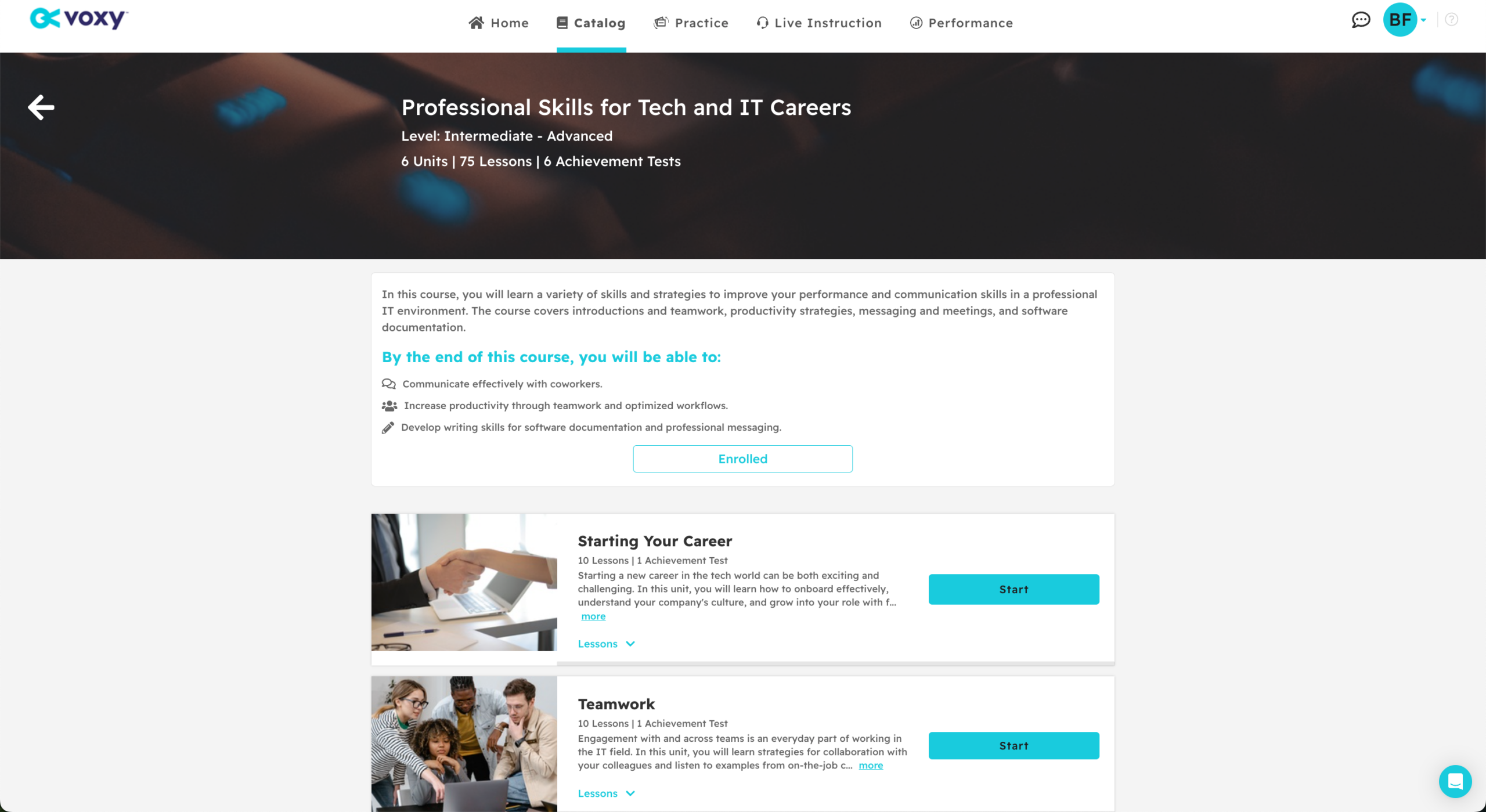
One of our role-specific courses for tech professionals is Professional Skills for Tech and IT Careers, a 75-lesson course across 6 units designed for learners at the Intermediate level and above. Each unit mirrors the actual flow of a tech professional’s week:
- Starting Your Career. Onboarding into a new role, decoding company culture, and building the team relationships that make early days productive.
- Teamwork. Cross-team interdependencies, communicating empathetically, requesting help without losing momentum, and explaining technical concepts to non-tech colleagues.
- Productivity. Focused work strategies, prioritization and goal-setting, managing distractions, and protecting time for deep work.
- Messaging. Choosing the right platform, internal messaging best practices, and the unwritten norms of async communication culture.
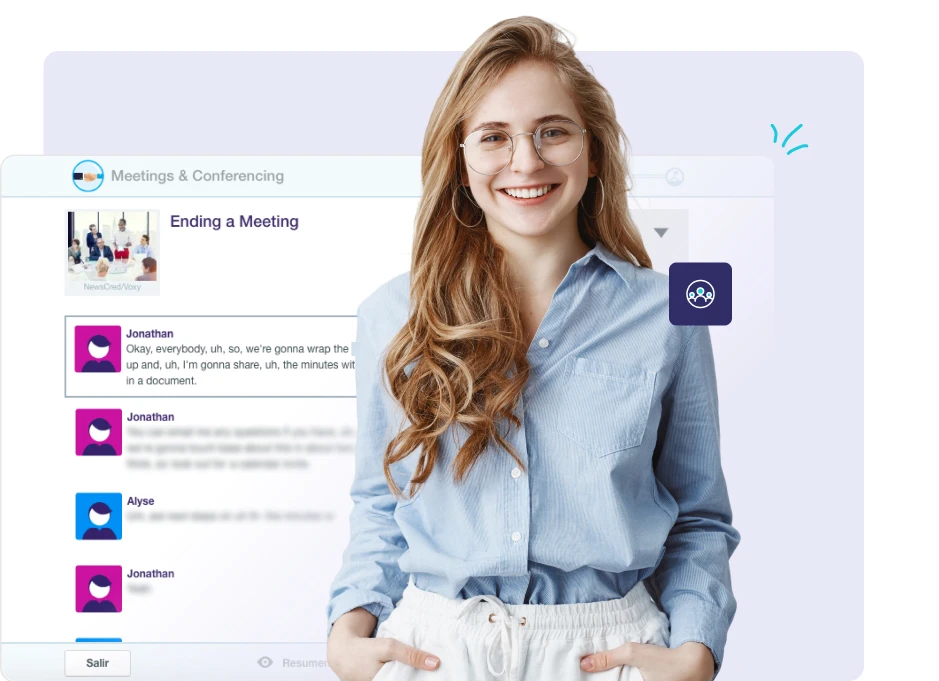
- Meetings. Preparing for and running effective meetings, asking sharp clarifying questions, giving updates with confidence, and presenting to a room.
- Documentation. Technical writing that holds up under review, clear documentation language, and the skills that turn a sprint’s work into knowledge the next person on call can use.
Every lesson is built around authentic material, from real onboarding playbooks to workplace videos drawn from companies tech professionals will recognize. The course also adapts to each engineer’s role, level, and goals, surfacing the lessons that will move their work the most. A senior developer brushing up on documentation language sees a different path than a new hire navigating their first stand-up.
Personalization at this scale only works when someone is steering the program. Voxy’s Customer Success team partners with L&D leaders from rollout to outcomes reporting, so the team focused on shipping the product can stay focused on it. And when teams want to move fastest, the self-paced course pairs with Voxy’s live instruction in group or one-on-one classes with certified instructors. Self-study builds the language while live practice cements it.
What to do next
The path from technical excellence to global impact runs through communication. If your tech team is ready to move past generic business language training and into language that actually reflects their workday, request a demo and we’ll walk you through what language training for tech teams could look like at your organization.
Voxy offers language training designed to reflect real corporate life, with courses tailored to different industries, departments, and roles. Our content helps professionals gain confidence in real work situations—from writing clear emails to participating in global meetings. Powered by AI and microlearning, our digital solution enhances team communication and unlocks your workforce’s full potential. Schedule a demo today.